Sand Lake is one of the many sole land selections that will be transferred to the Algonquins of Greater Golden Lake First Nation upon the completion of the Treaty.
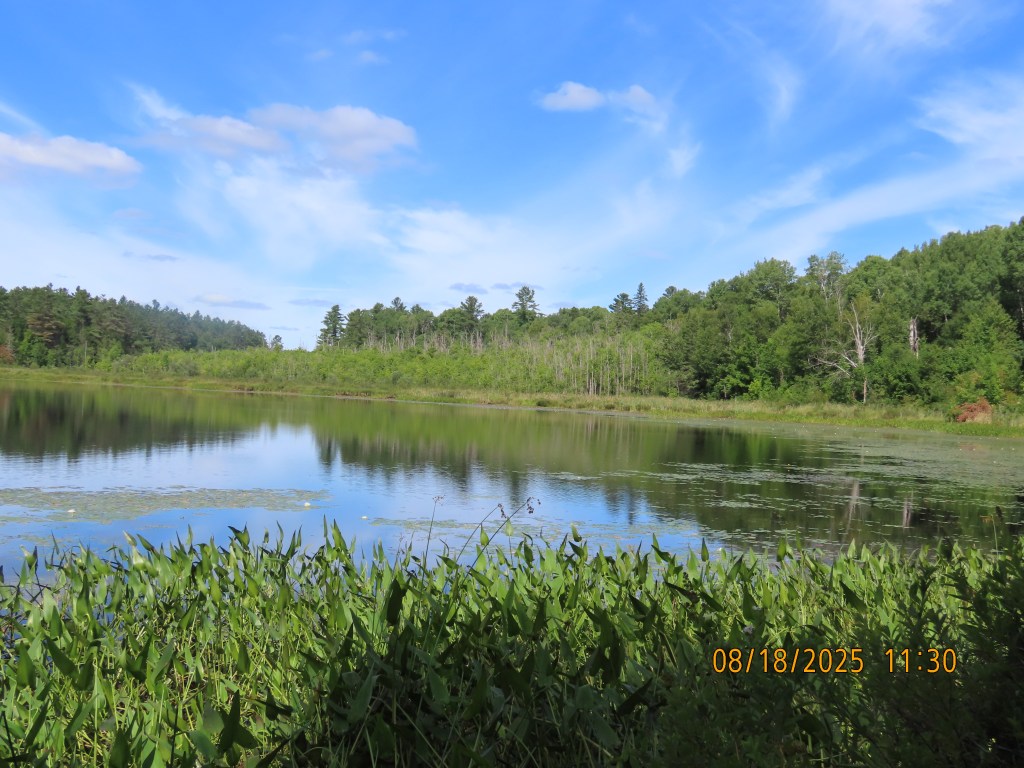
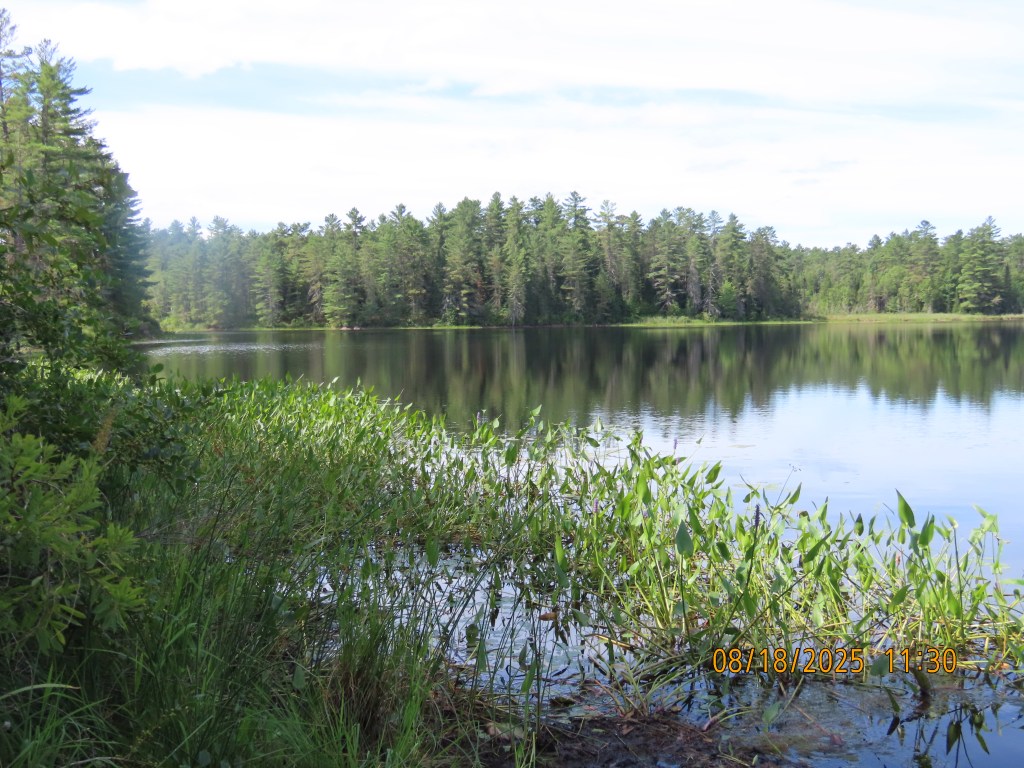
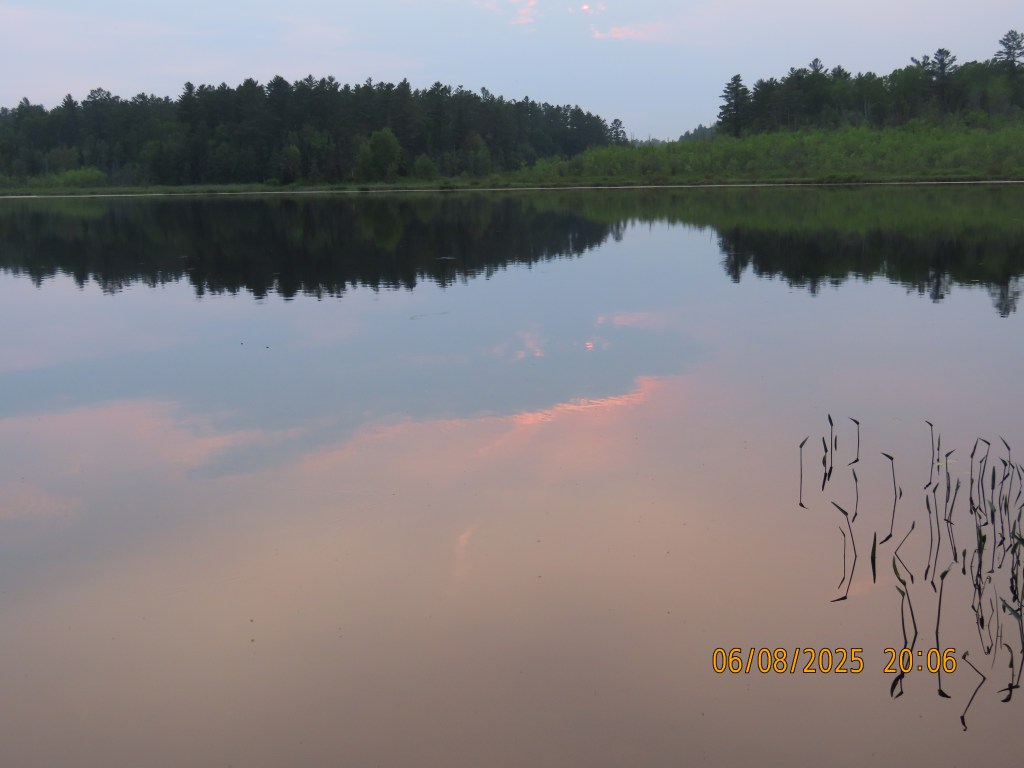
Sand Lake is located at Km 9 just off Baron Canyon Road
Before the Sand Lake Gate Entrance
GPS Coordinates: 45°48’59.9″N. 77°27’47.0″W.
It is approximately 40 acres of land with easy access to Sand Lake.
Sand Lake is surrounded by a vast variety of forestry, marsh lands and wetlands.
And this lake is known to be home to many different Species at Risk.
SPECIES AT RISK 2025 SAND LAKE PROJECT # 1
From the spring through the fall of 2025, the Algonquins of Greater Golden Lake First Nation carried out a Species at Risk project at Sand Lake with funding provided through a grant from the Centre for Indigenous Environmental Resources (CIER).
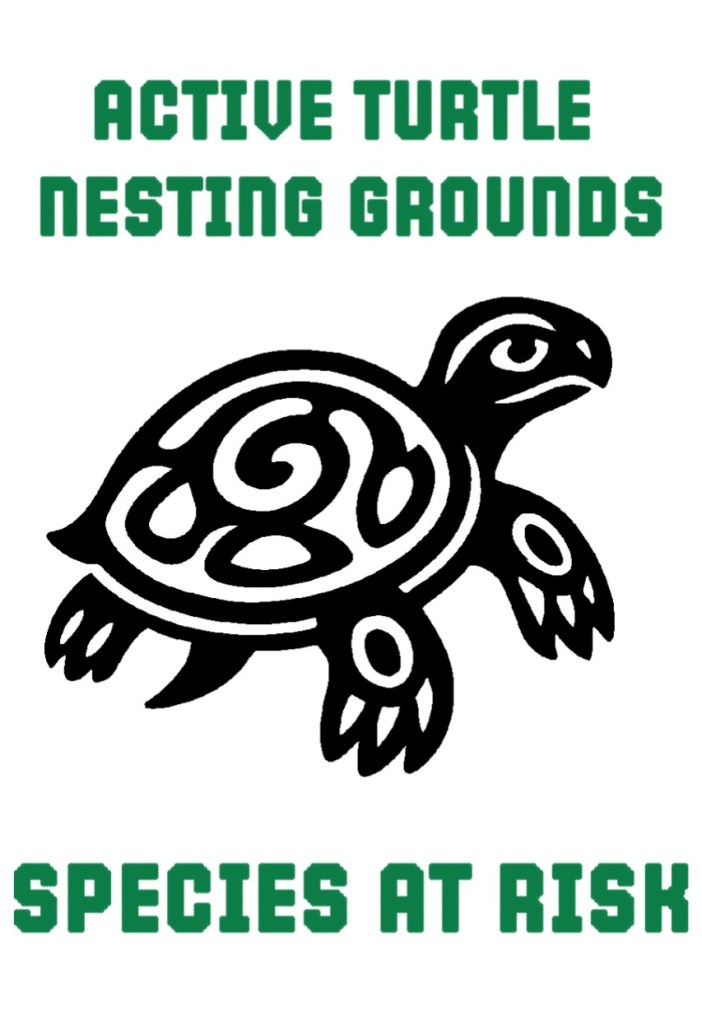
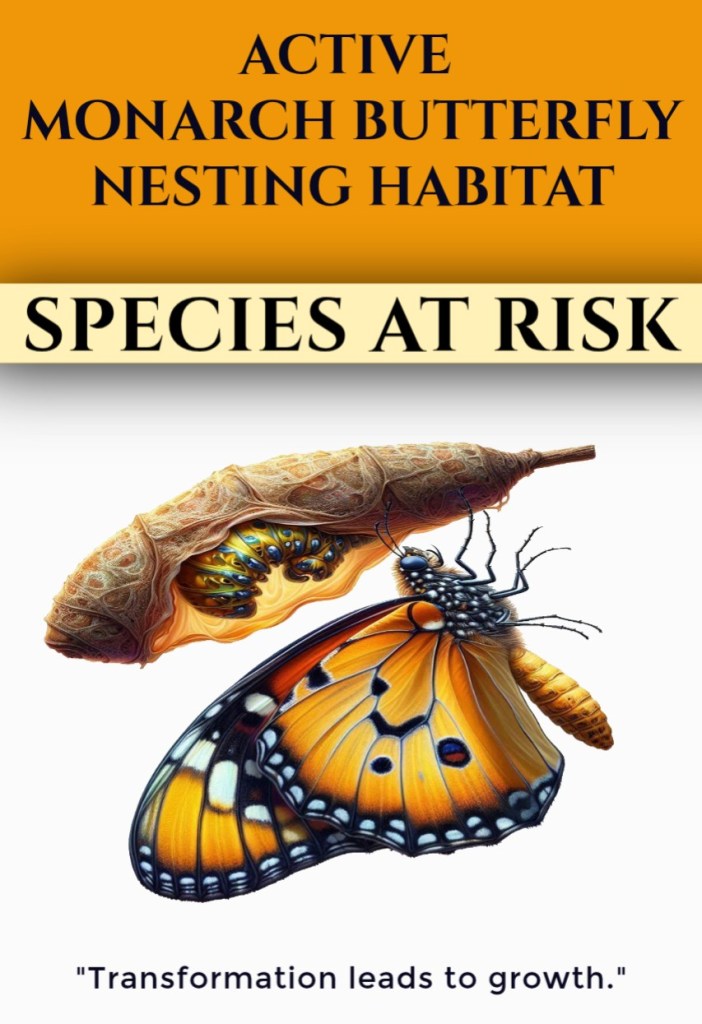
Some of you may have noticed the black silt fencing, turtle nest protection cages, and informational signs placed throughout the area. These measures were part of our efforts to help protect species at risk and their habitats while raising awareness within the community.
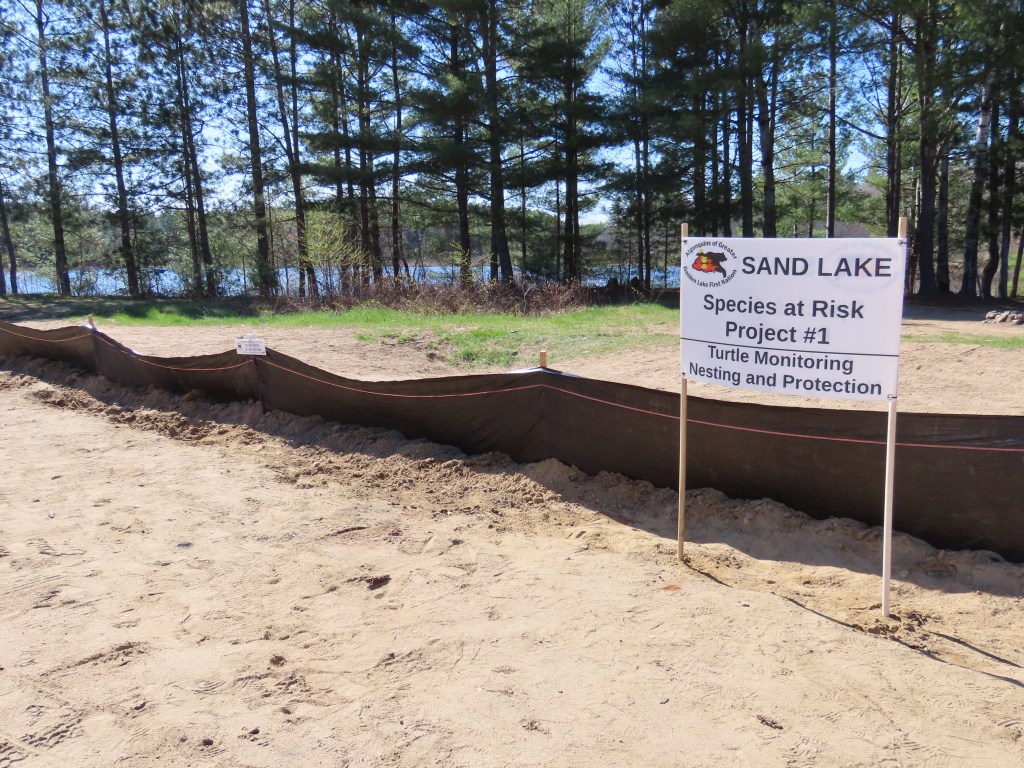
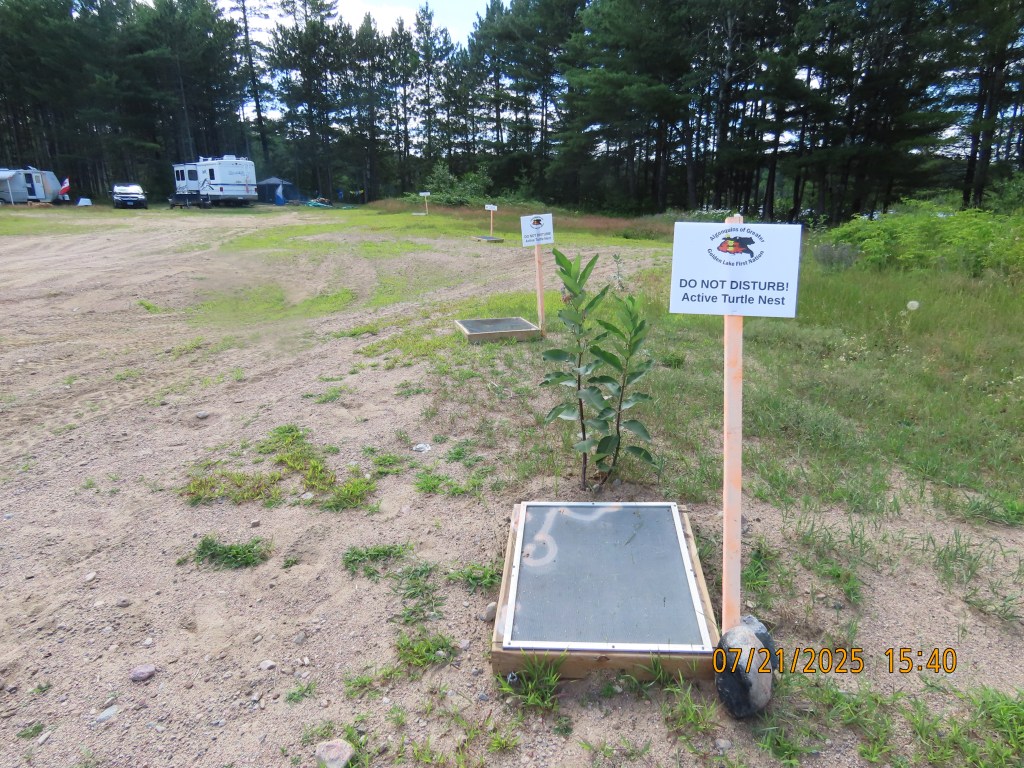
Our main focus was on four Species at Risk: the Eastern Whip-poor-will, the Eastern Wolf, the Monarch Butterfly, and the Blanding’s Turtle. We discovered that three of these four species call Sand Lake home. The only species we did not encounter was the Eastern Wolf; even though we did not observe it at this site, however, it may still pass through the area late at night.
As for the three Species at Risk that we did find, we were not able to physically locate the Eastern Whip-poor-will, but we were successful in capturing audio recordings of its distinct call. We were also able to photograph Blanding’s Turtles, Monarch Butterflies, and Monarch Caterpillars during the project.
As we came across fresh turtle nesting sites, we placed protective cages over them to help keep predators away and reduce the risk of human disturbance.
Despite experiencing some significant setbacks to our recovery efforts, we consider our 2025 Species at Risk Project to have been a success overall.
We would like to extend our sincere thanks to all of our volunteers and to our two monitors. It is because of your dedication, hard work, and support that we believe our efforts helped protect and preserve some of these Species at Risk.
We are grateful for everything you contributed to the project, and we look forward to continuing this important work this year and in the years ahead.
4 SPECIES AT RISK PHOTOS
If you are not familiar with these four Species at Risk, we encourage you to take a few minutes to look through the photos and information provided below.
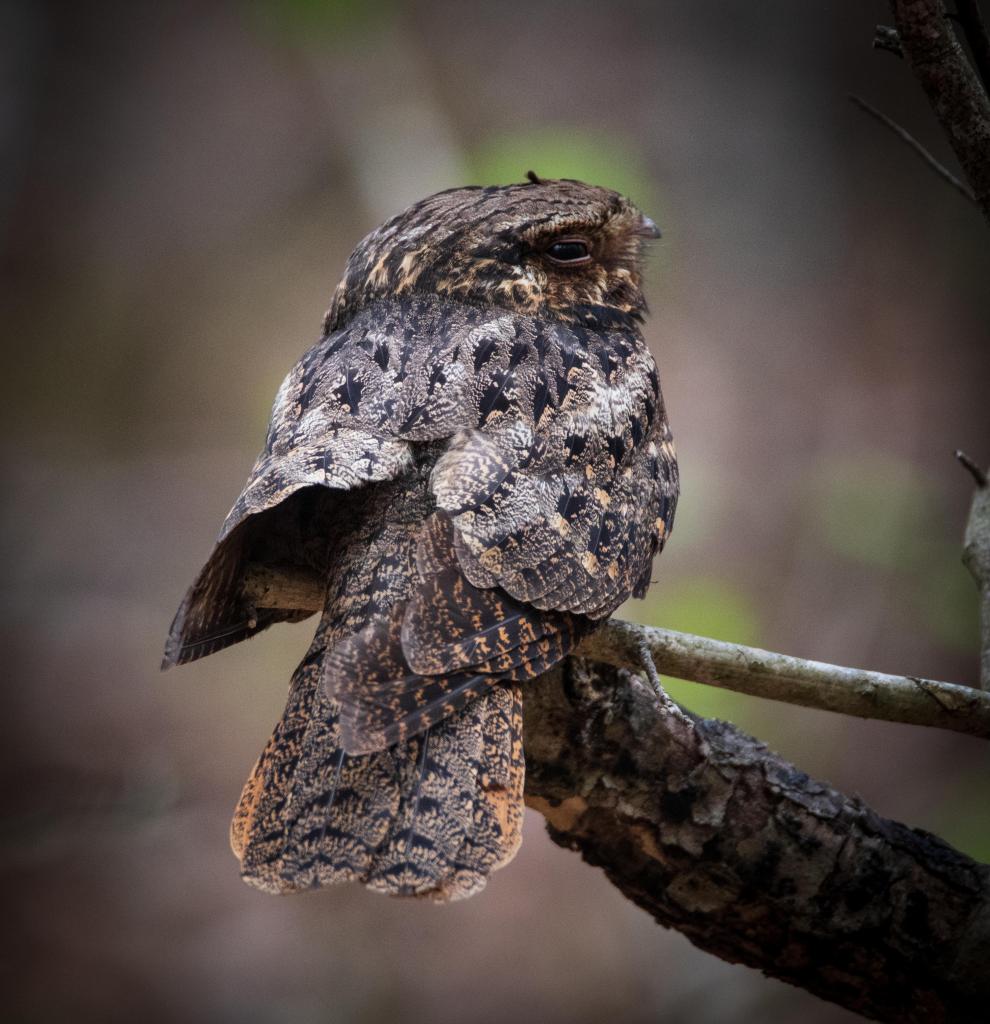
This is a photo of the Eastern Whip-poor-will. Please be careful when walking through forested areas, as these birds nest directly on the ground where its colorings means it will easily remain undetected by visual predators. Whip-poor-wills forage only at dawn or dusk but can forage all night during moonlit nights. These nocturnal birds are known for their continuous singing throughout the night, especially during the breeding season.
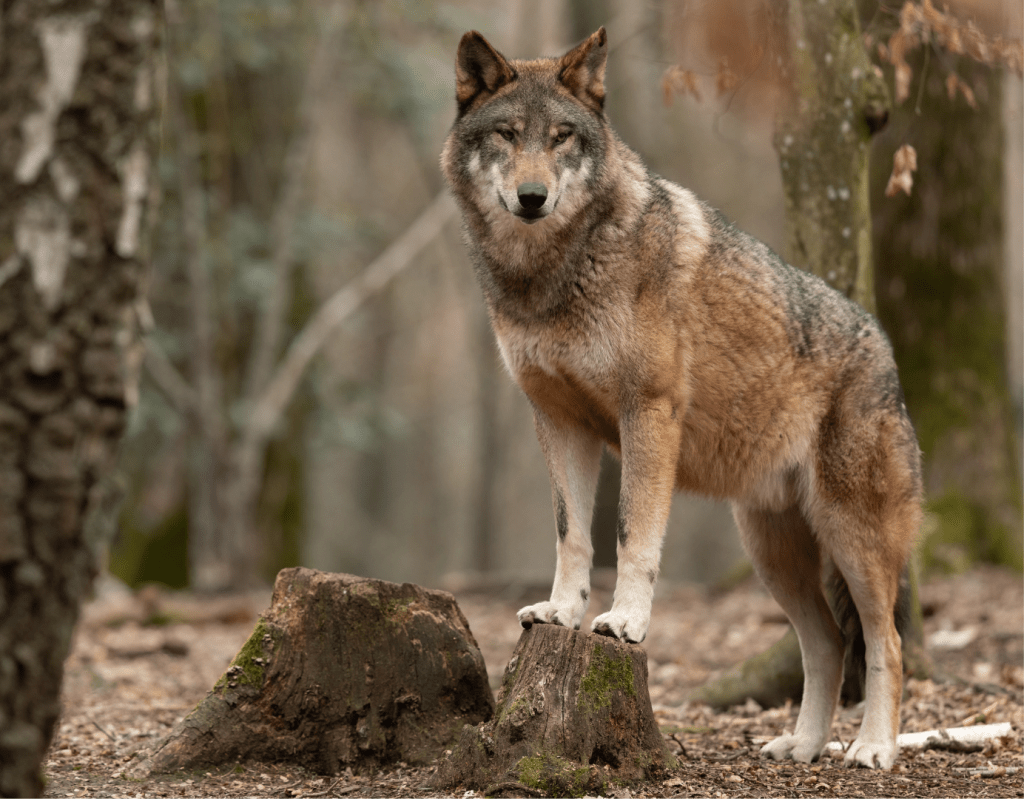
This is a photo of the Eastern Wolf. Although it has not been seen here during daylight hours, but it is possible that it may be in the area during the nighttime hours. So please use caution when outdoors at night.
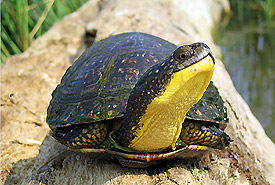
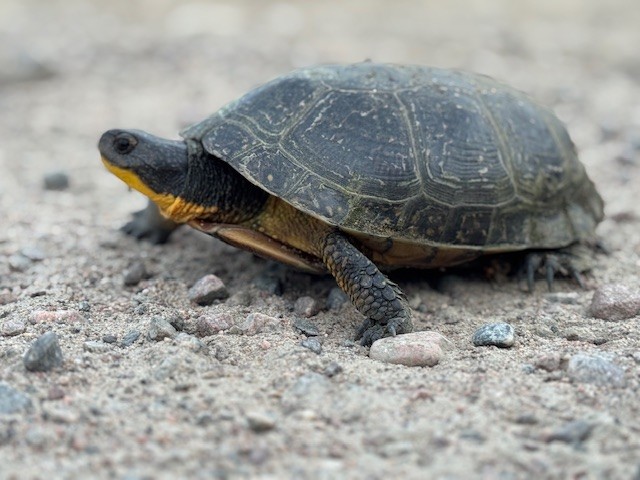
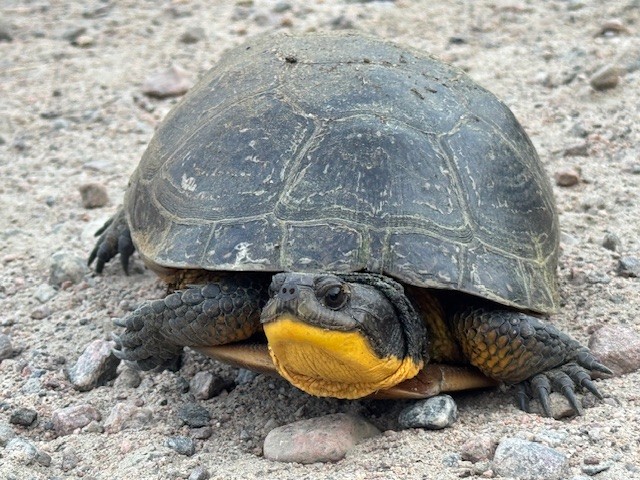
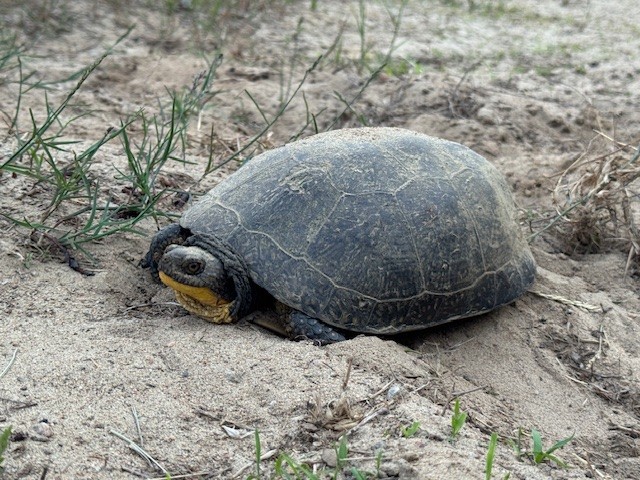
This is a photo of the Blanding’s Turtle. It can take up to 25 years to mature and can survive more than 75 years. It is easily identified by it’s bright yellow throat, and it’s domed, smooth upper shell that resembles an army helmet. The bottom of it’s shells is hinged so it can completely close it’s shell after pulling in it’s head and feet.
Nesting Locations: Blanding’s turtles prefer to nest close to water sources in sunny areas with good drainage, but they may travel considerable distances to reach a suitable site, sometimes up to 6 kilometers and it could even nest on the side of a road. Nesting, where the female lays her eggs, usually occurs between late May and early July. Females lay 3-25 elliptical eggs in a single clutch. Turtle Hatchlings emerge from the nests between August and September and can emerge as early as mid-August in warm years, or later in the fall in cooler years. Once hatchlings appear, they will travel as far as necessary to find their way to the nearest water source.
Habitat: Blanding’s turtles are primarily aquatic and spend a significant portion of their time in wetlands like marshes, swamps, and ponds.
Movement Corridor: The area within 250 meters of wetlands is considered a critical movement corridor for hatchlings to access the water.
Hibernation: Blanding’s Turtles hibernate in the mud at the bottom of permanent bodies of water from late October until the end of April.
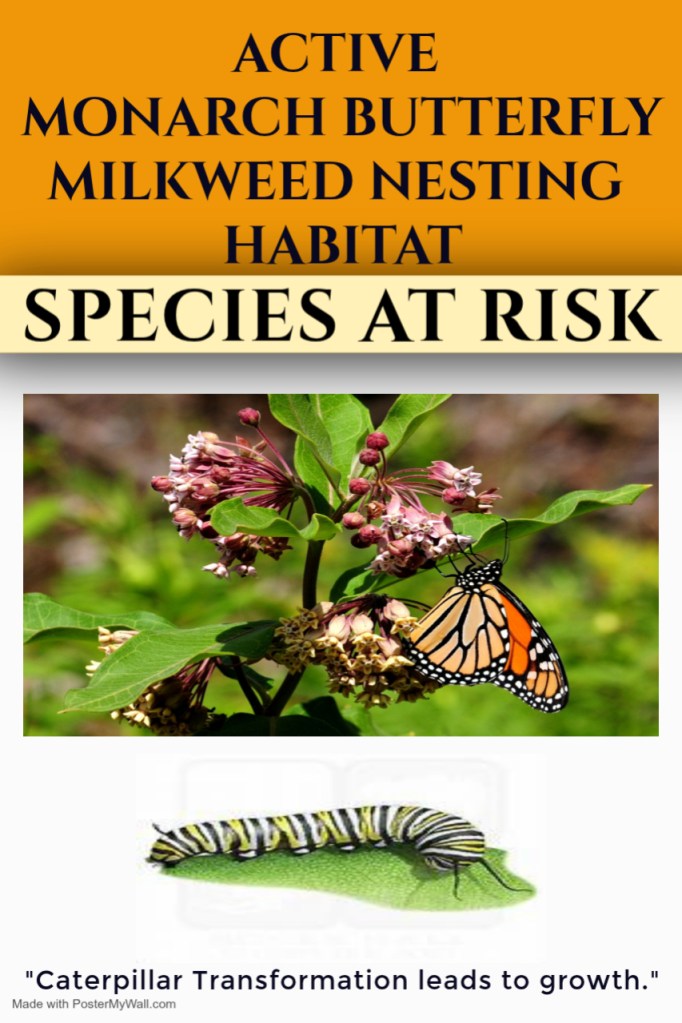
These photos are of the Monarch Butterfly and the Monarch Caterpillar.
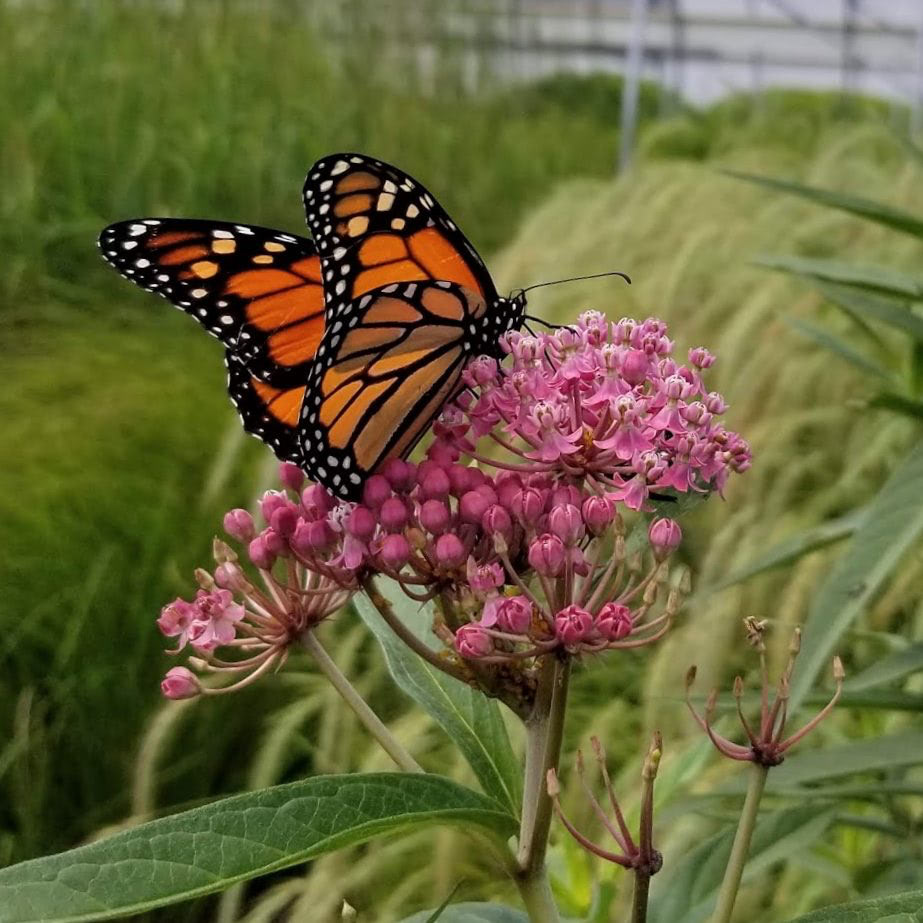
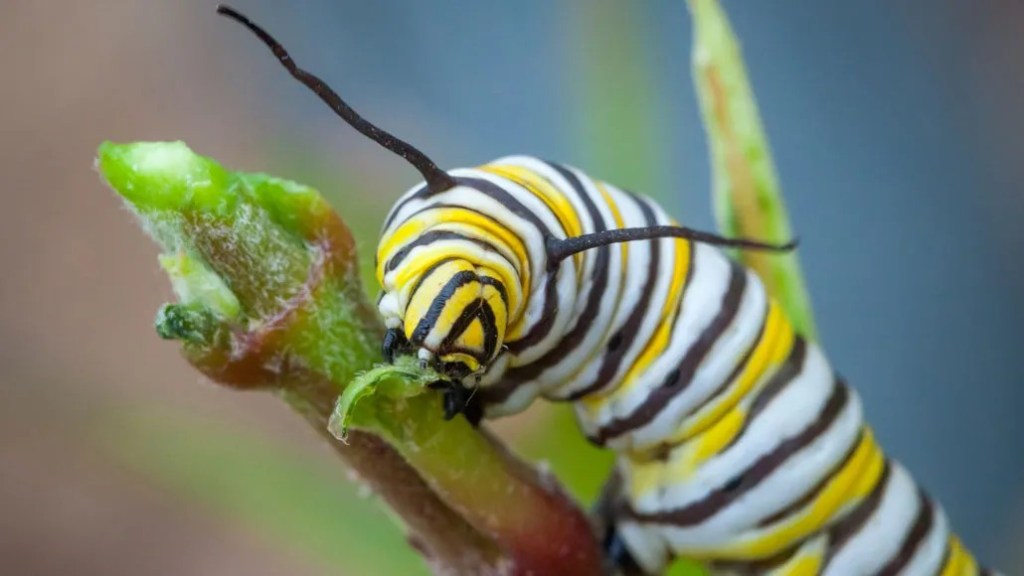
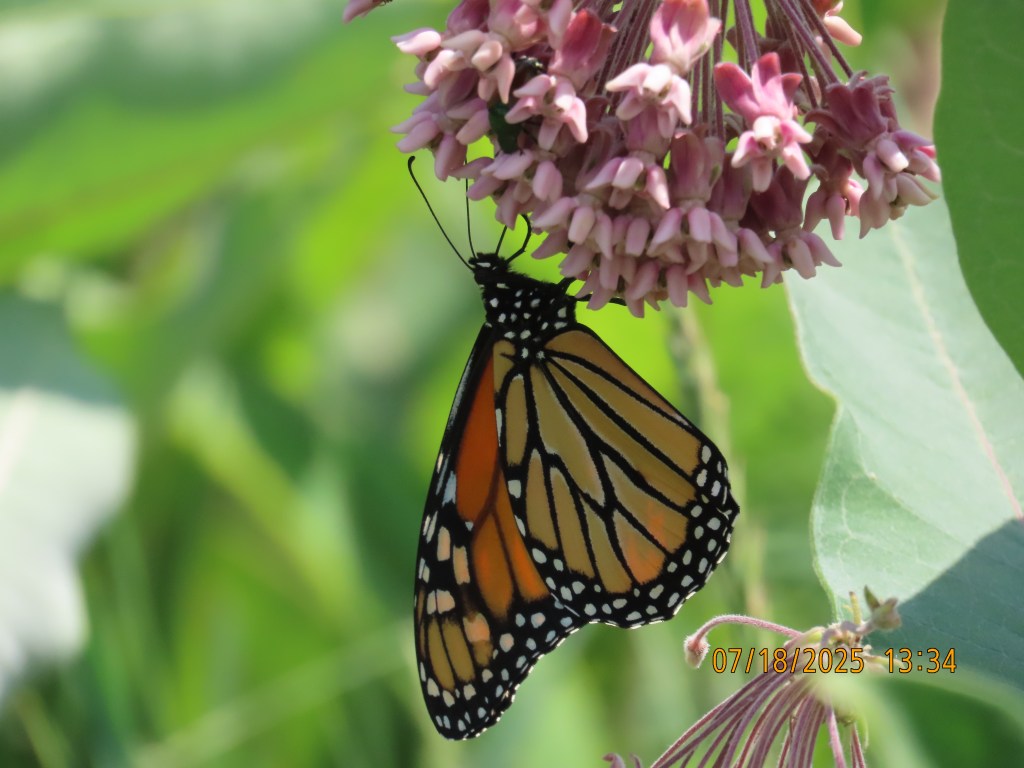
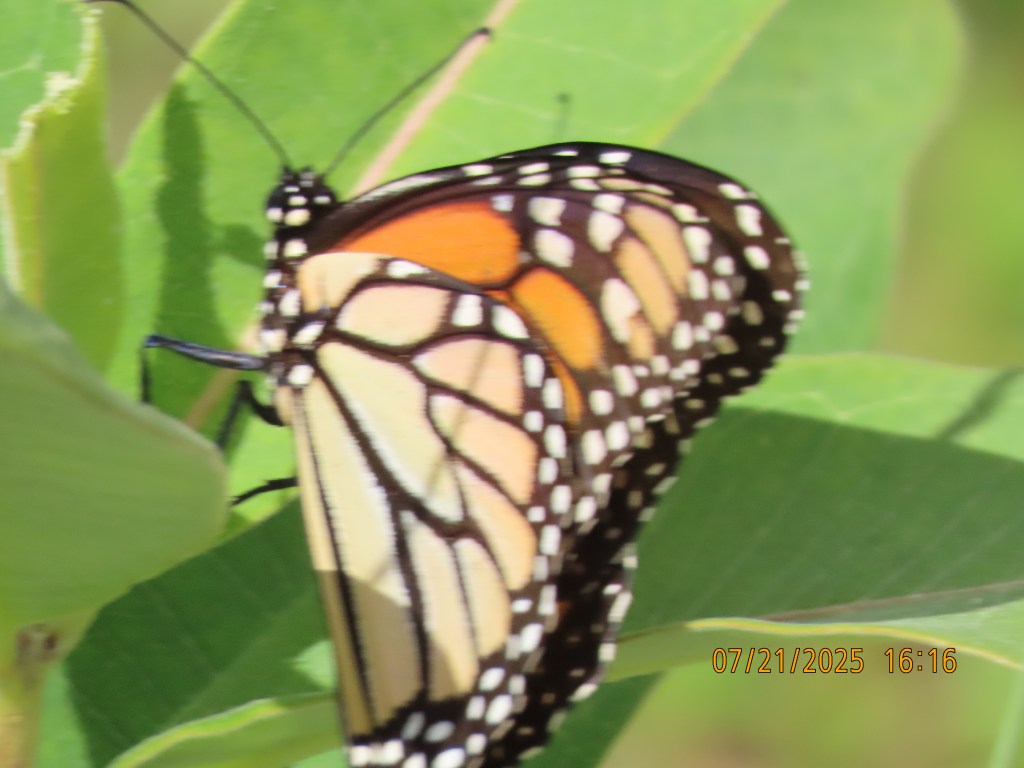
The Monarch butterfly is easily recognizable due to its vibrant orange, yellow and black wings with small white spots on the borders. They are relatively large, with a wingspan of about 9-10 cm.
The Monarch caterpillar is also distinct, displaying black, white, and yellow stripes, and can be found feeding on milkweed plants. The chrysalis stage is a striking jade-green color with golden spots.
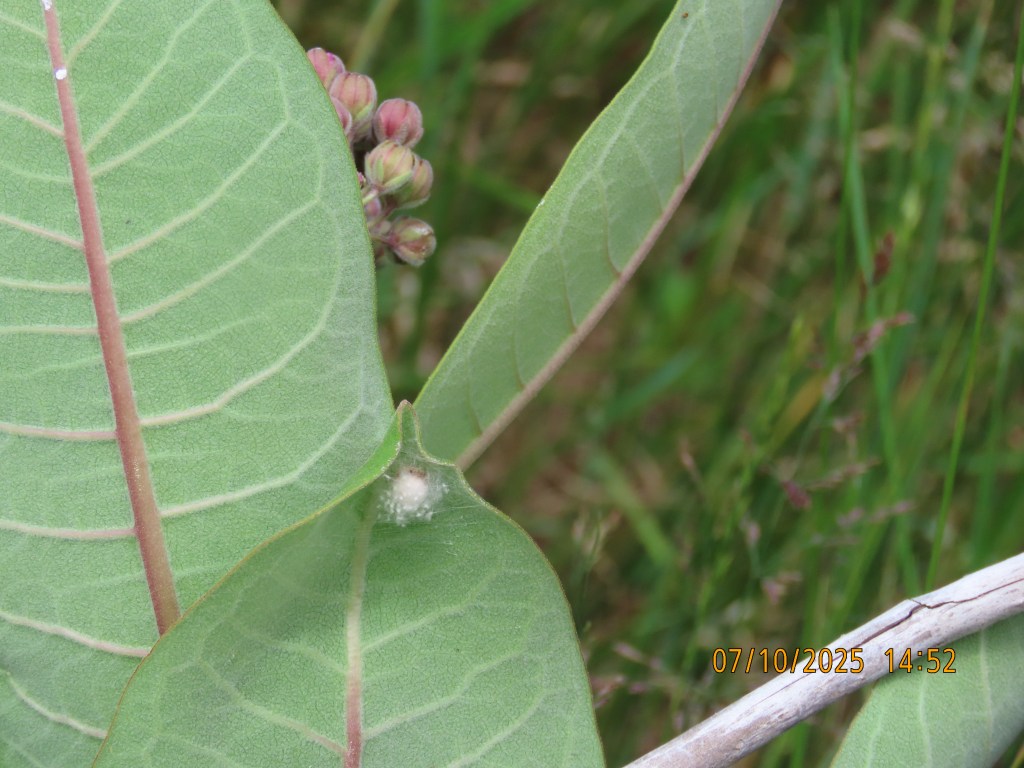
Monarch butterflies eggs are laid on the underside of milkweed, which is the sole food source for Monarch aterpillars. And adult Monarch butterflies depend on native wildflowers for nectar. To help save the Monarch Butterfly, we must protect and avoid damaging milkweed and native wildflowers.
Monarch butterflies lay approximately 400 pin size eggs on the underside of the milkweed plants in Ontario. These eggs hatch into caterpillars within 3-12 days, which then develop into pupae (chrysalises) before emerging as adult butterflies.
After laying hundreds of eggs, the initial generation transitions into the next, dying off as the new spring generation emerges. Each generation continues this cycle, mating and laying eggs until September, when the next butterflies are prepared for migration. While females typically die after laying eggs, adult male butterflies also die post-mating, to prevent competition with their offspring.
After arriving in Mexico, the females lay eggs, and it is their offspring that continue the journey north to reproduce in Ontario, usually arriving in early June.
Below, you will see the 11-step lifecycle of the Monarch Butterfly.
Can you follow the 11 amazing steps beginning with Step #1?
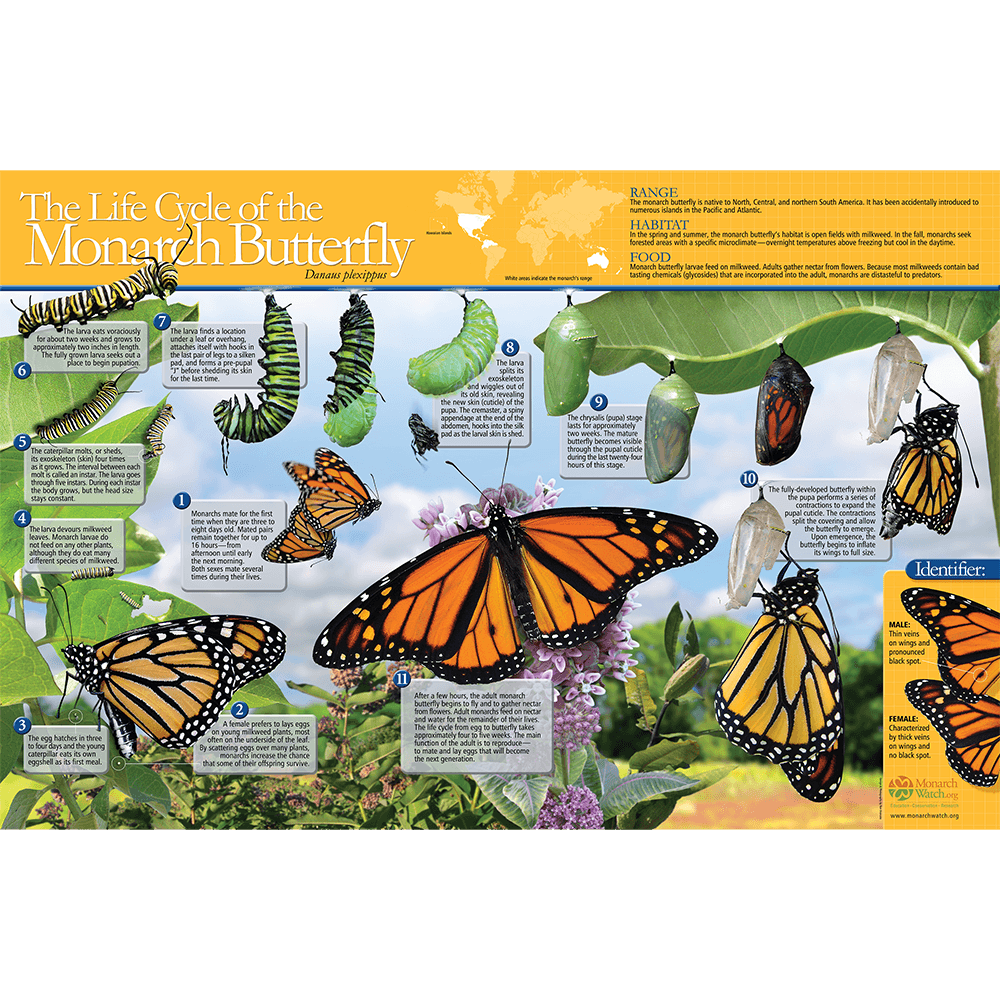
Sorry this photo is hard to read, so listed below are the 11-steps life cycle
# 1-Monarchs mate for the first time when they are 3-8 days old. Both sexes mate several times during their lives.
#2-Several eggs are laid on the underside of multiple milkweed leaves to increase the chances for the survival rate for their offspring.
#3-Eggs hatch in 3-4 days and the young caterpillars eat their own eggshell as it’s first meal.
#4-Monarch Larva do not eat other plants, but they do eat many different species of milkweeds.
#5-The caterpillar molts or sheds it’s skin four times as it grows. The interval between each molt is called an instar. The larva goes through five instars, its body continues to grow but it’s head size stays constant.
#6-The larva eats voraciously for about 2 weeks and grows up to 2 inches in length. The fully grown larva seeks out a place to begin pupation.
#7-The larva finds a location under a leaf or overhang, attaches itself with hooks in the last pair of legs to the silken pod and forms a pre-pupal “J” before shedding its skin for the last time.
#8-The larva splits its exoskeleton and wiggles out of its old skin, revealing the new skin of the pupa. The cremaster, a spiny appendage at the end of the abdomen, hooks into the silky pod as the larval skin is shed.
#9-The chrysalis (pupa) stage lasts for approximately 2 weeks. The mature butterfly becomes visible through the pupal cuticle during the last twenty-four hours of this stage.
#10-The fully developed butterfly within the pupa performs a series of contractions to expand the pupal cuticle. The contractions split the covering and allow the butterfly to emerge. Upon emergence, the butterfly begins to inflate its wings to full size.
#11-After a few hours the adult butterfly begins to fly and to gather nectar from flowers. The life cycle from egg to butterfly takes approximately four to five weeks. The main function of the adult is to reproduce- to mate and lay eggs that will become the next generation.
SPECIES AT RISK 2025 SAND LAKE PROJECT # 1
We discovered six Blanding’s Turtles at Sand Lake, and one was observed making a nest on the side of Baron Canyon Road, just a few kilometers before Sand Lake. We should be cautious while driving to, from, and in the general area around this lake.
SPECIES AT RISK 2025 SAND LAKE PROJECT # 1
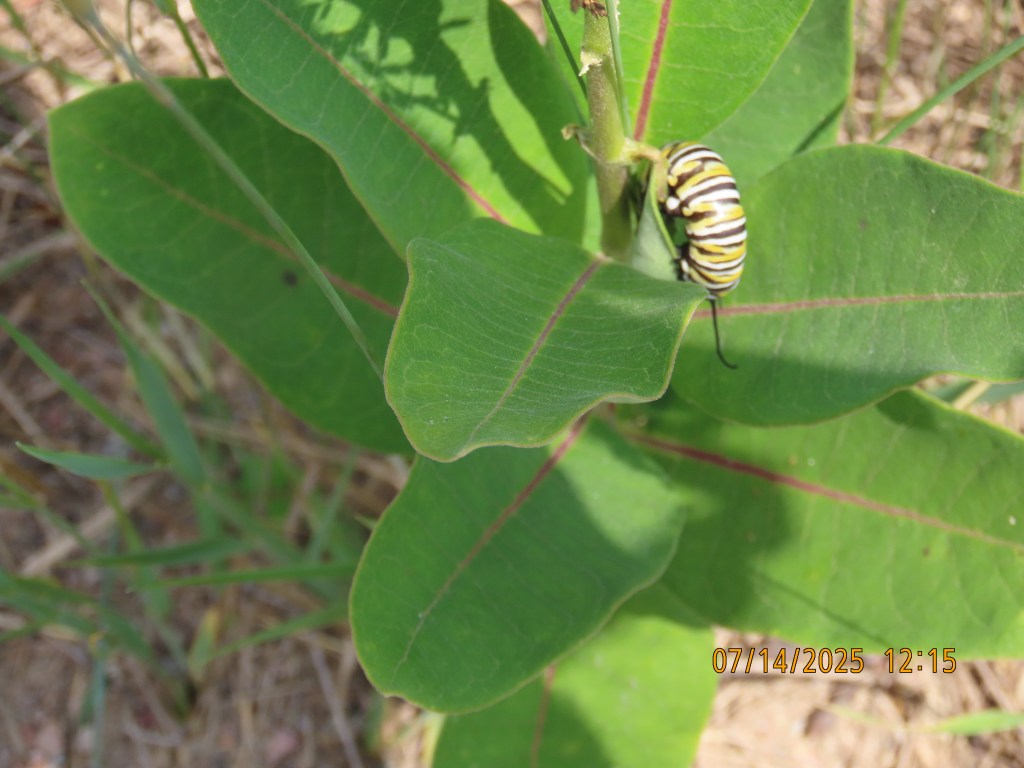
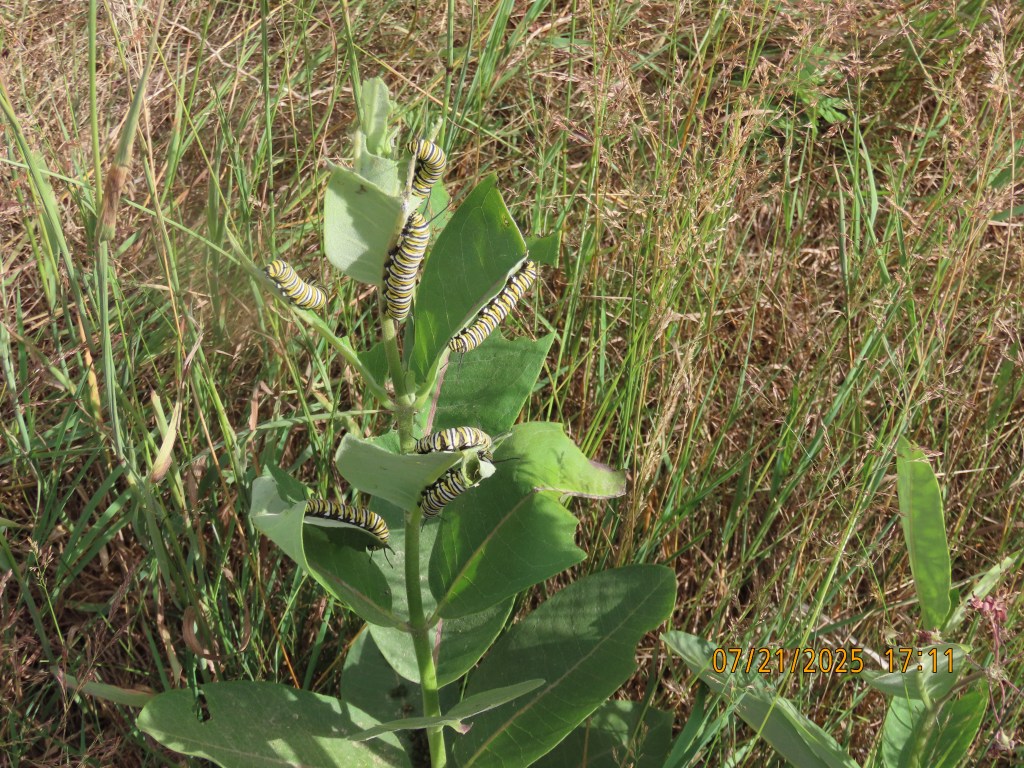
We came across a few Monarch Butterflies and Monarch Caterpillars on the milkweed plants at Sand Lake. We should try not to destroy these plants, because they are essential to the butterflies’ survival.
Below is a the final Power-Point Presentation that was submitted for review by CIER for the 2025 Species at Risk Project
Milkweed is a favorite in butterfly gardens, not only because it is the host plant for the monarch and queen butterflies, but because the nectar is sought by many butterflies, bees, and hummingbirds. If you’d like to help, you can plant some milkweed seeds in one of your own flower gardens in the fall. They are actually a very big beautiful flowering plant, but they are toxic. When handling milkweed, avoid contact with the milky sap by wearing gloves. If you touch the sap, wash your hands immediately to avoid getting it in your eyes.
For the home gardener, it is easier to confine your milkweed plants to an area away from curious pets. Common milkweed (A. syriaca), swamp milkweed (A. incarnata) and butterfly weed (A. tuberosa) are planted often in the garden. The tuberosa variety does not have the toxic milky sap and blooms off and on all summer with bright orange flowers. Pollinators flock to the flowers on all milkweed varieties, which also produce interesting seed pods.
SPECIES AT RISK 2026 SAND LAKE PROJECT # 2
Once again, the Algonquins of Greater Golden Lake First Nation are conducting a Species at Risk project at Sand Lake from the spring through the fall of 2026. Unlike last year’s project, which was made possible through grant funding from the Centre for Indigenous Environmental Resources (CIER), this year’s work is being carried out without external funding. Despite this, we remain committed to protecting species at risk and their habitats, continuing our stewardship efforts through monitoring, conservation, and community awareness initiatives.
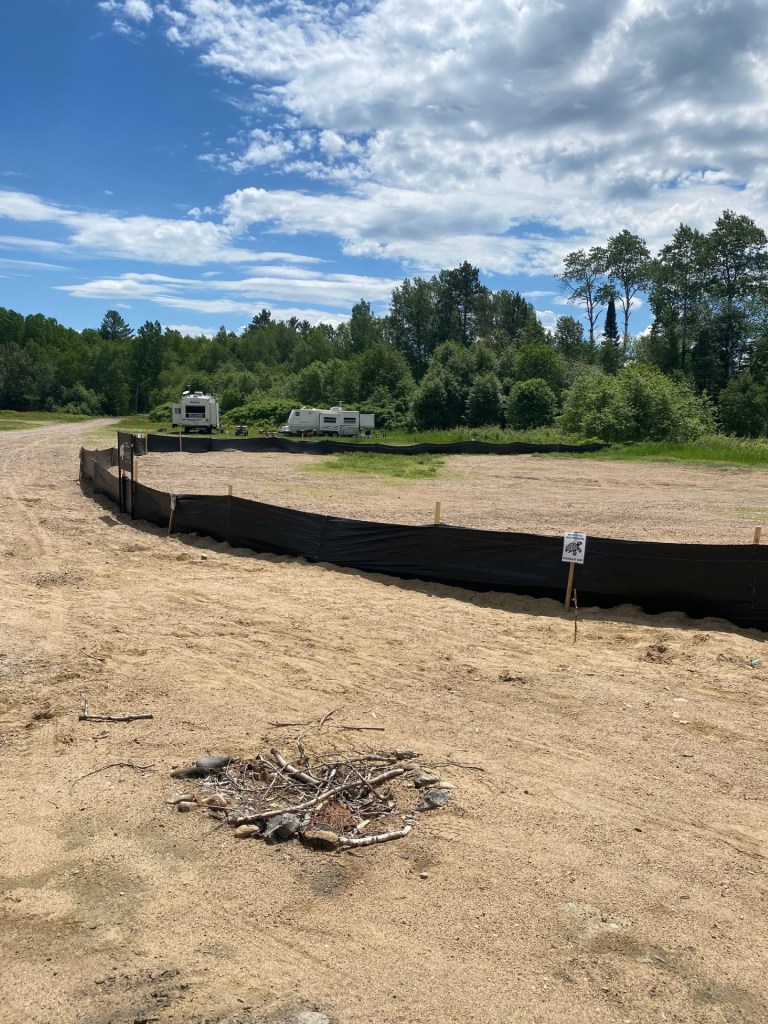
This year our main focus is on all Turtles and Monarch Butterflies. During this time, you will see black silt fencing installed and turtle nest protective cages placed in specific locations, along with signage to help protect not only just the Blanding’s Turtles, but the Painted Turtles, the Snapping Turtles, and their eggs from predators and human disturbance.
To protect the Monarch Butterfly and its caterpillars, we must first protect their natural habitat and food sources. Native wildflowers provide an important nectar source for adult Monarch butterflies, while milkweed plants are essential for Monarch caterpillars, serving as their primary food source and the only plant on which Monarchs lay their eggs.
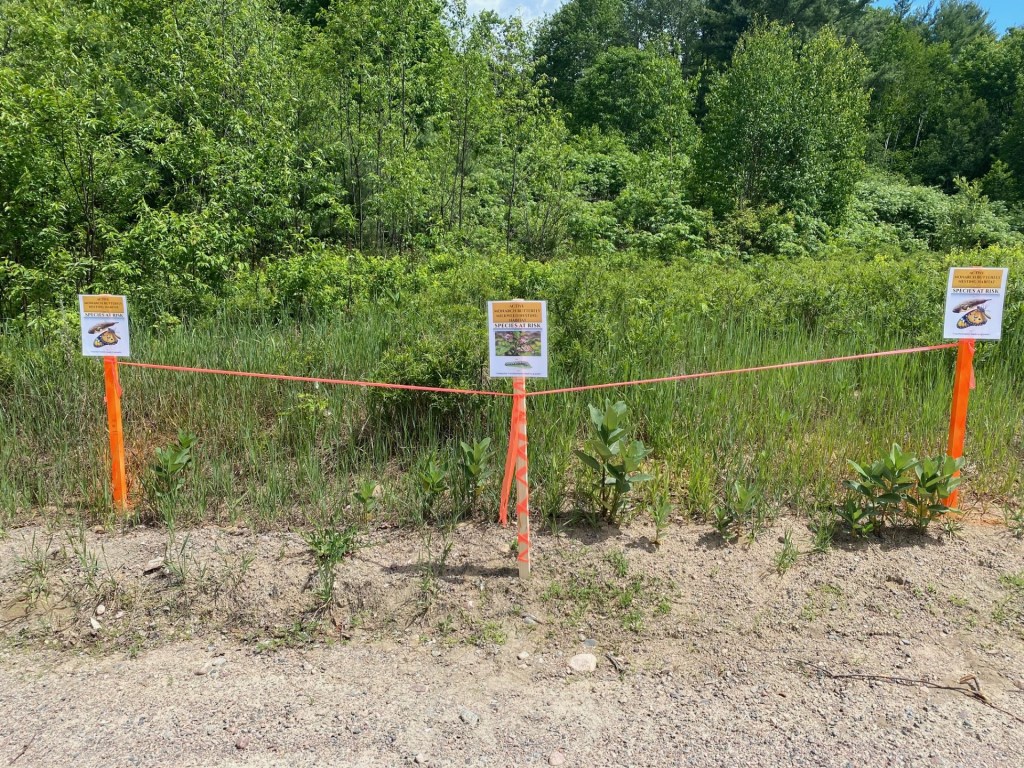
To help safeguard these critical habitats, we are installing orange snow fencing with informational signage, or orange marker pickets with signage placed periodically around or near milkweed patches. These protective measures help prevent damage caused by all-terrain vehicles (ATVs) and other disturbances, allowing milkweed and native wildflowers to thrive and continue supporting Monarch butterfly populations.
For those who visit this area for recreation, we would like to emphasize that our goal is not to interfere with or disrupt your family’s enjoyment of the outdoors. We encourage everyone to continue enjoying Sand Lake while respecting and supporting this conservation project.
We kindly ask for your cooperation in helping to protect these Species at Risk and their habitat. One of the most important ways you can assist is by not damaging, removing, or disturbing the protective measures and recovery strategies that have been put in place.
A significant amount of time, effort, volunteer work, and funding is invested in establishing and maintaining these conservation measures. Their purpose is to protect critical habitat, support species recovery, and help ensure the long-term survival of these Species at Risk for future generations to enjoy and appreciate.
Your understanding, respect, and support are greatly appreciated.
FIELD TRIPS – MAY 28, 2026 & JUNE 11, 2026
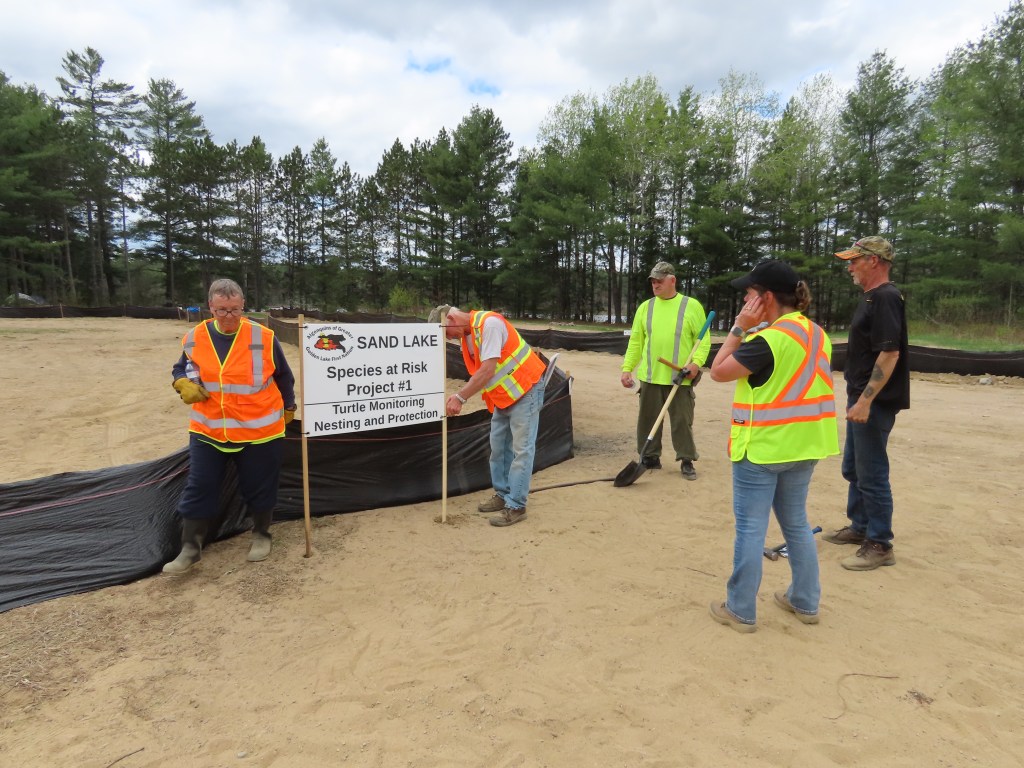
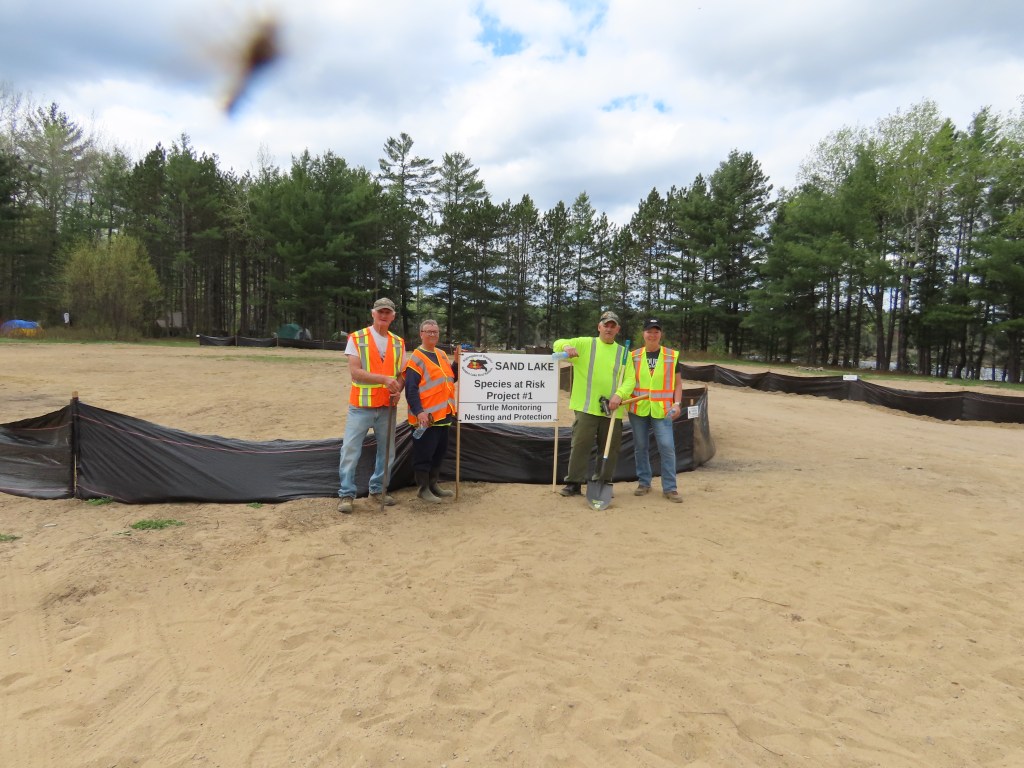
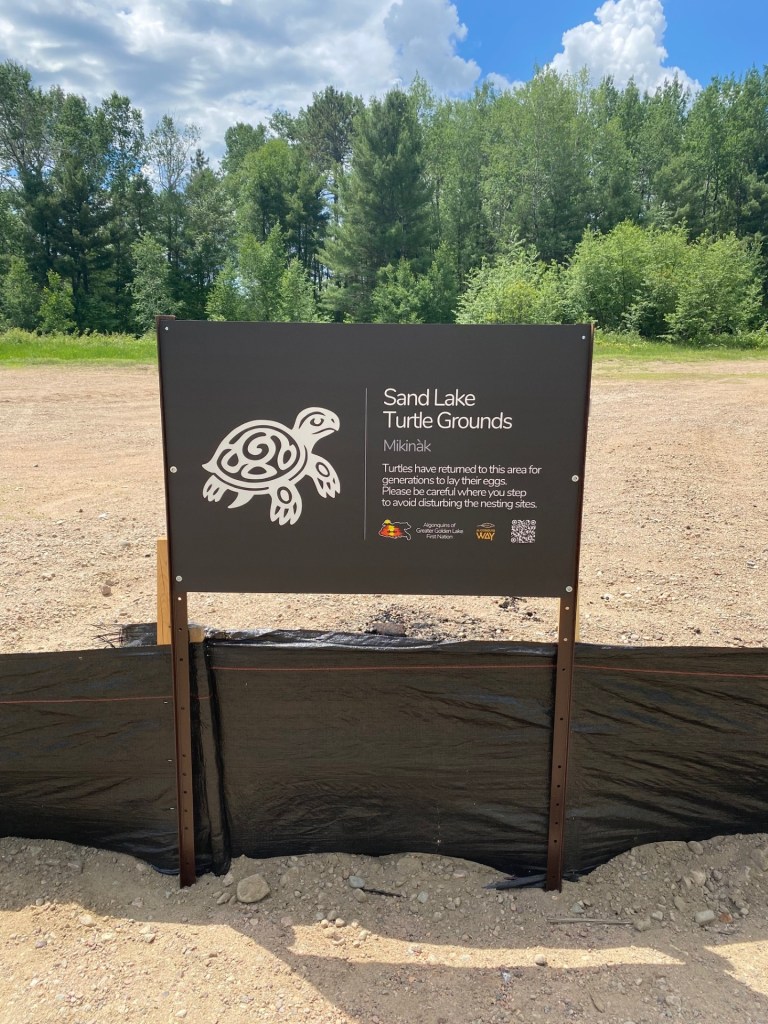
We recently conducted our first field trip with office staff and a few dedicated volunteers to help advance our Blanding’s Turtle and Monarch Butterfly habitat protection projects. During this outing, we installed educational signage and approximately 1,500 feet of silt fencing for the Turtles and sections of snow fencing around an area containing a large patch of milkweed plants, which are essential for Monarch caterpillars.
While measuring the site, we underestimated the diameter of the milkweed plant area and found ourselves slightly short of snow fencing before completing the enclosure.
Fortunately, we purchased additional snow or safety fencing and we returned for our second field trip on June 11, 2026 to finish the installation for this enclosure. While there, we repaired some of the silt fencing that was damaged by that nasty gusty wind storm we got the week before. And we also installed a large metal informational sign with a QR Code near the silt fencing. If you scan the QR Code it will bring you right to this page on our website.
We would like to extend our sincere gratitude to the volunteers who joined us on these two field trips. (Stephen Moreau, Larry Henry, Jeff Caughey). Your hard work, dedication, and support played a vital role in the success of this project. Conservation efforts such as these would not be possible without the generosity of community members who are willing to donate their time and energy to help protect Species at Risk and their habitat.
Thank you for making a positive difference.
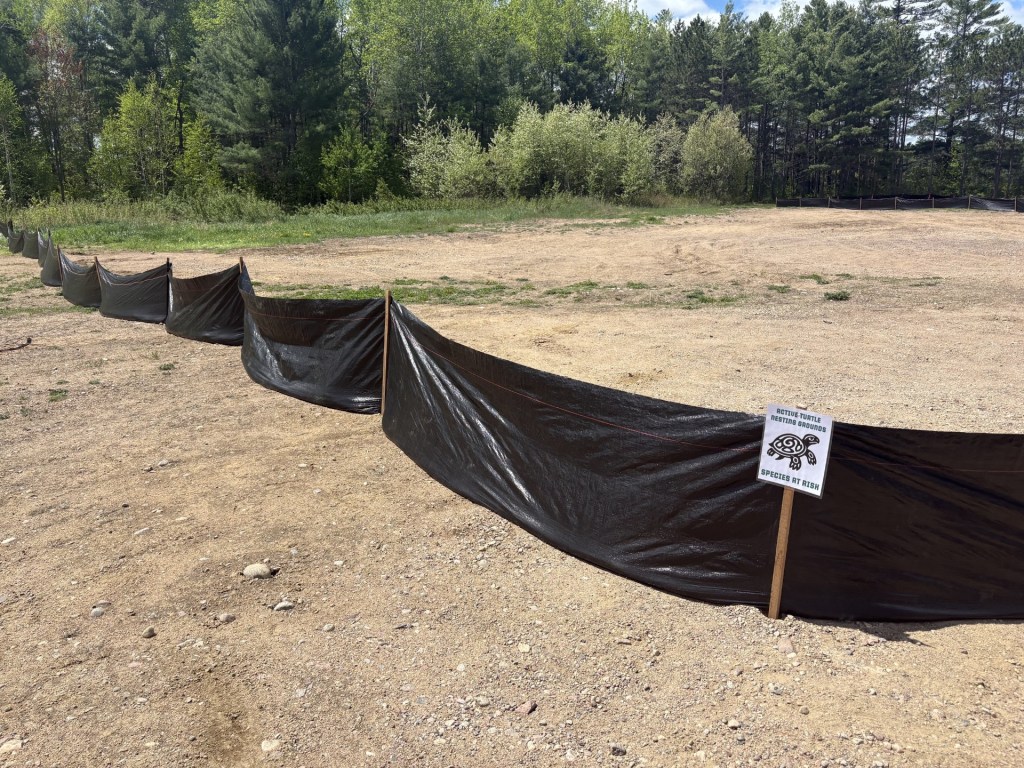
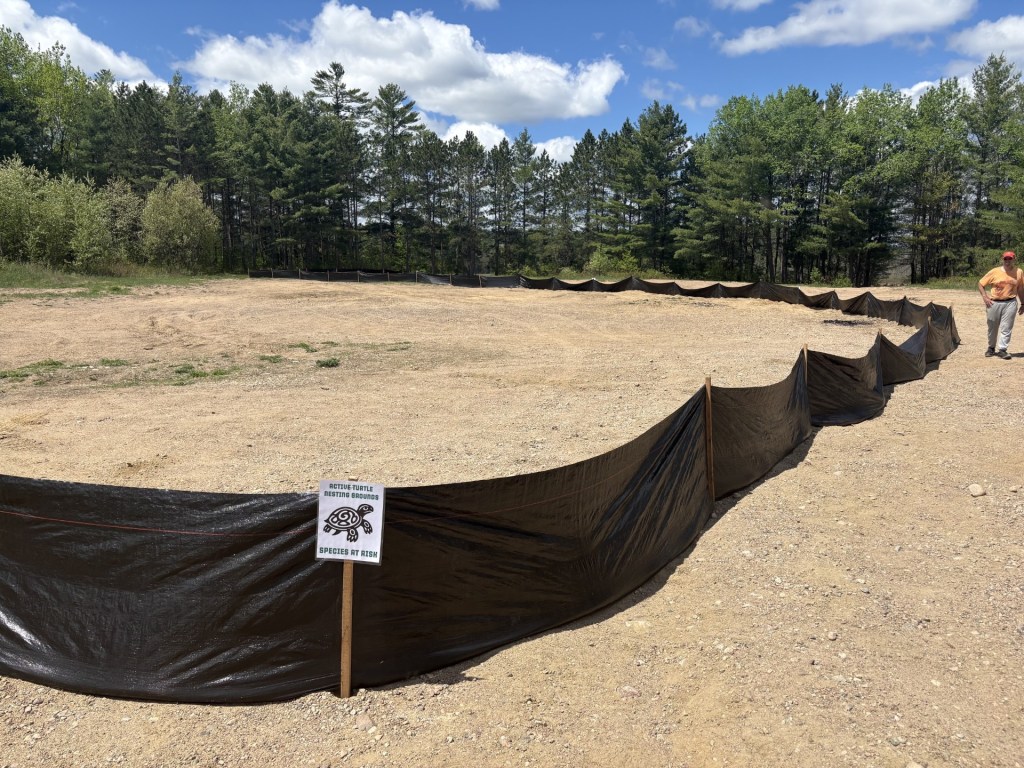
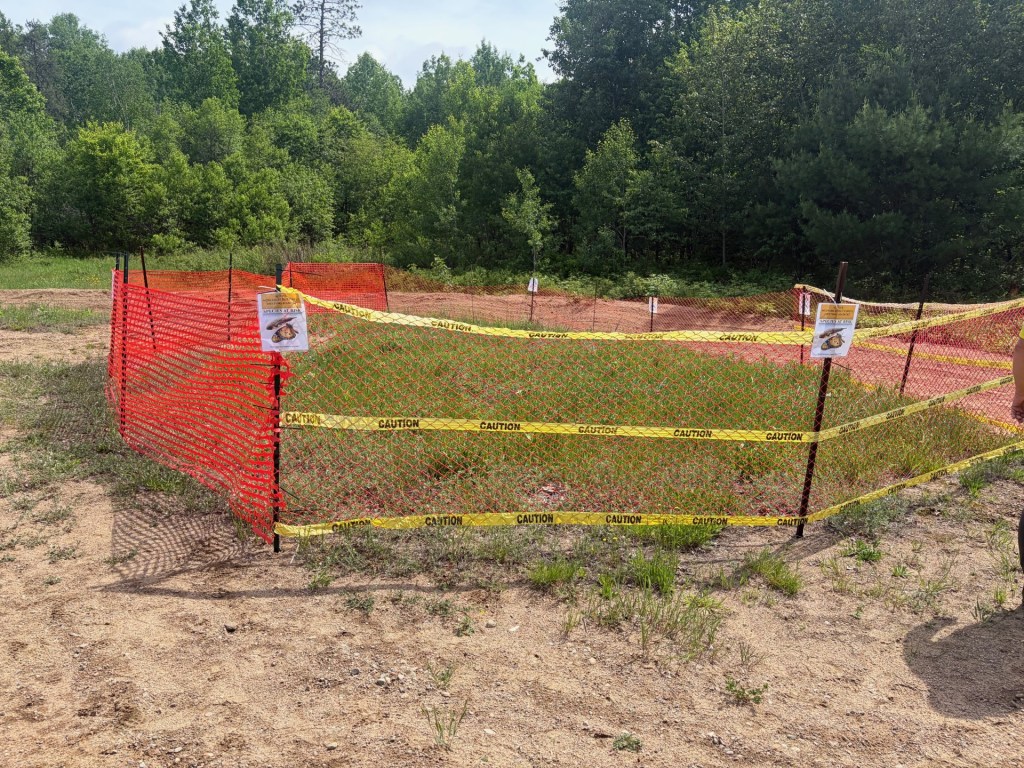
AT SAND LAKE THIS YEAR YOU WILL SEE FENCING WITH POSTED SIGNS, 4 FT PICKETS WITH POSTED SIGNS & PROTECTIVE TURTLE NESTING CAGES
We are grateful to the individuals shown below, from left to right, whose support, dedication, and hard work made the launch of our 2026 Species at Risk Project # 2 at Sand Lake possible. Their contributions have helped ensure that we can continue protecting and monitoring species at risk, even without external funding.
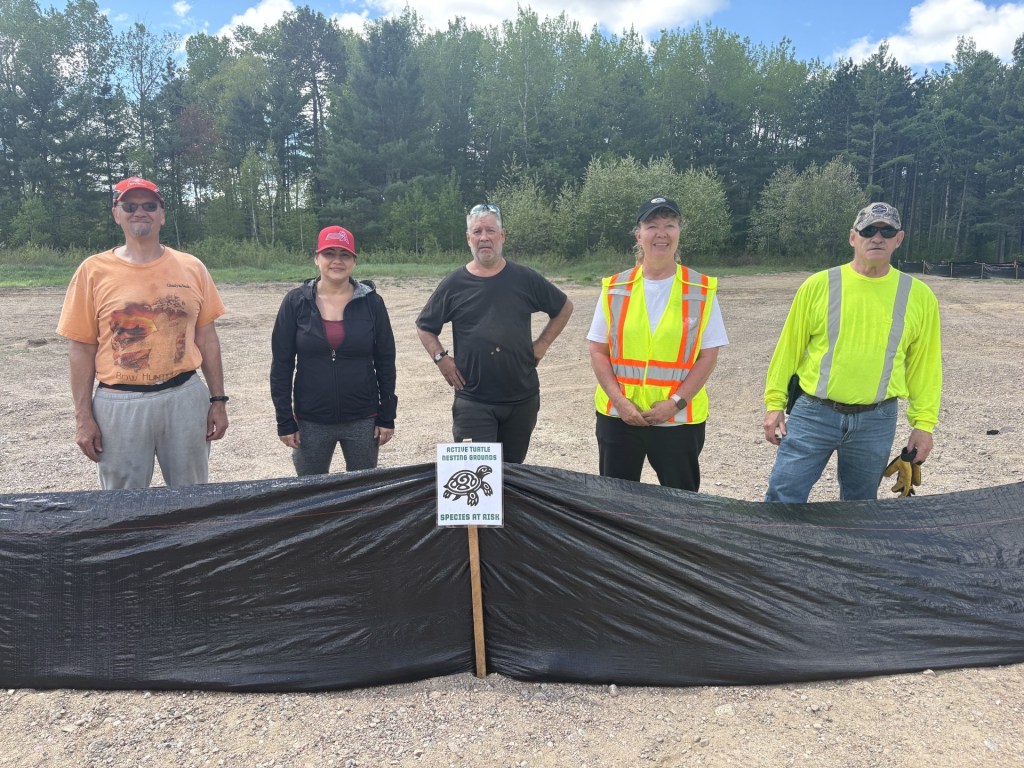
Starting on the left – Volunteer-Stephen Moreau, Employee-Kayla Martinat, Volunteer-Jeff Caughey, Employee-Denise Chaput, Volunteer-Larry Henry and the photographer was Chief-Paul Laderoute
Recovery Strategies In Place at Sand Lake
Field Trip – June 16, 2026
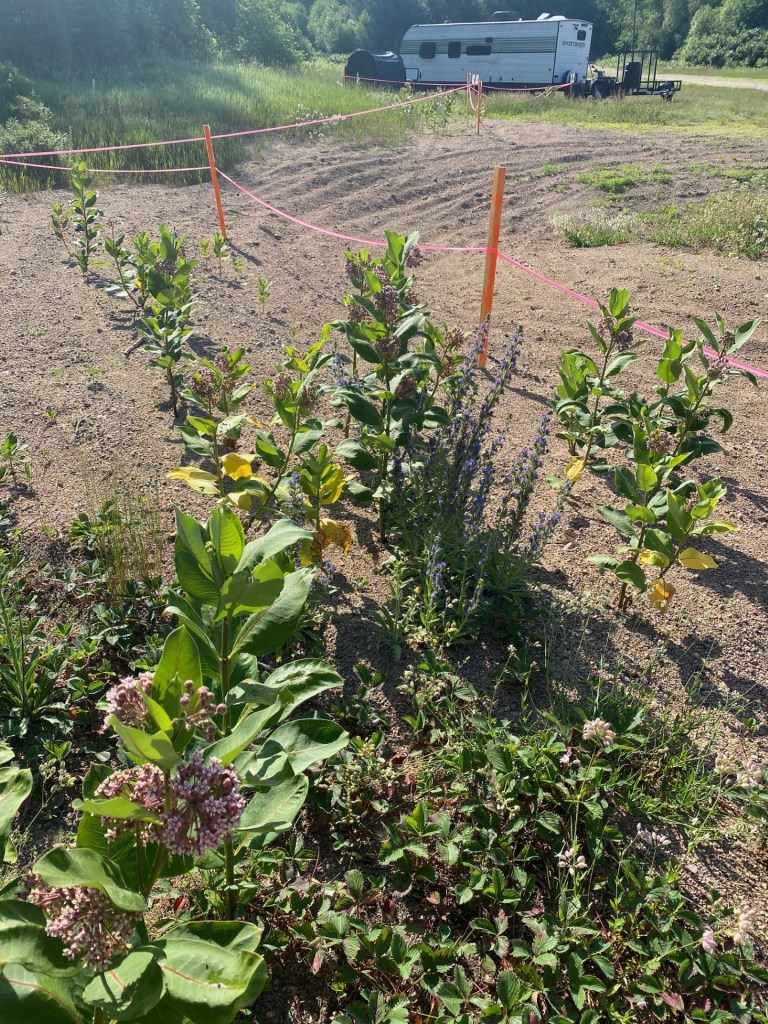
To protect the natural habitat of Milkweed plants for the Monarch Butterfly and Caterpillars, pickets with signage and flagging tape were installed by Denise Chaput on a solo field trip on June 16, 2026.
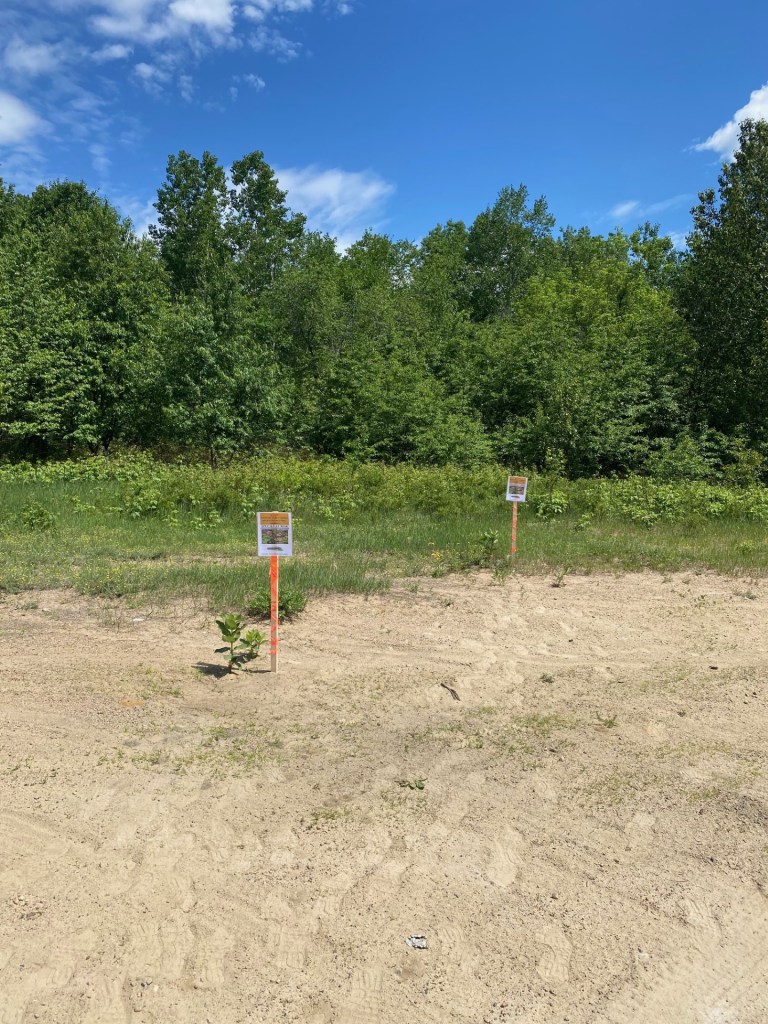
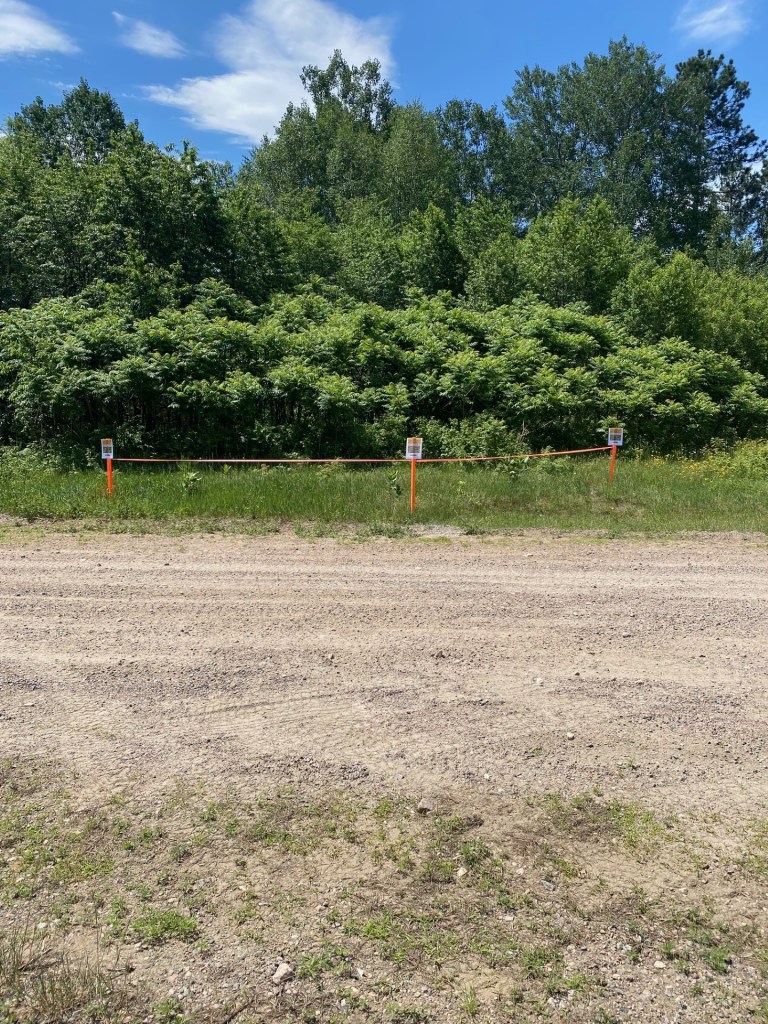
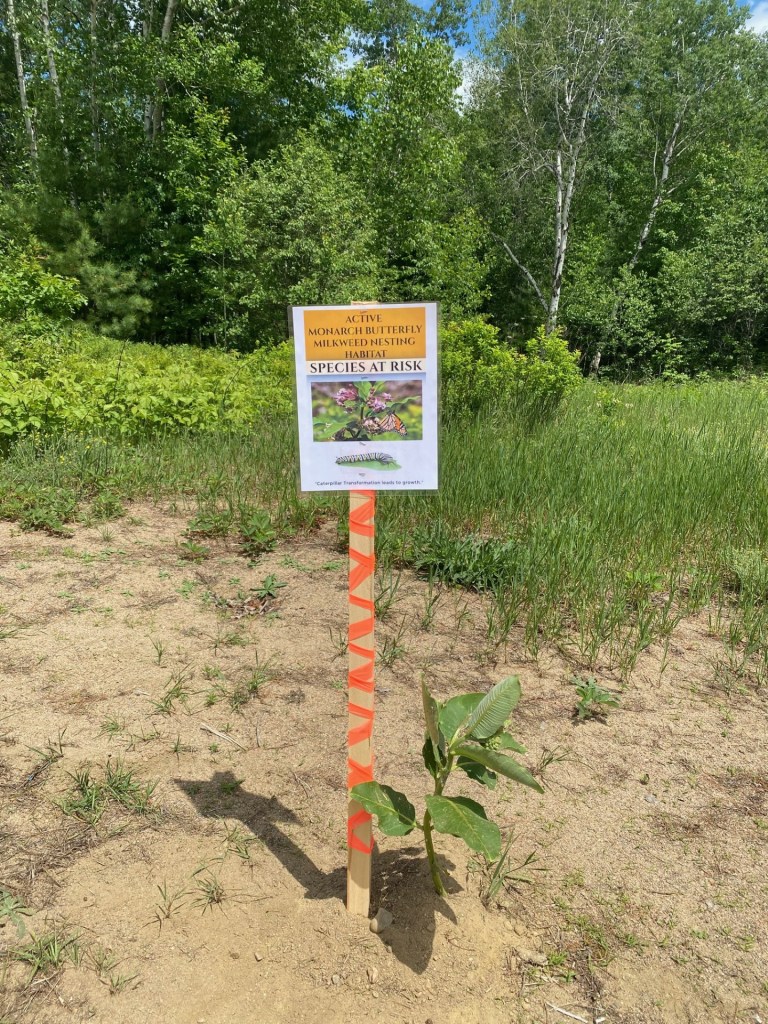
This poor milkweed plant was already ran over by a vehicle. Tried to save it! So it was stood back up and supported with banked sand and the picket with a sign.
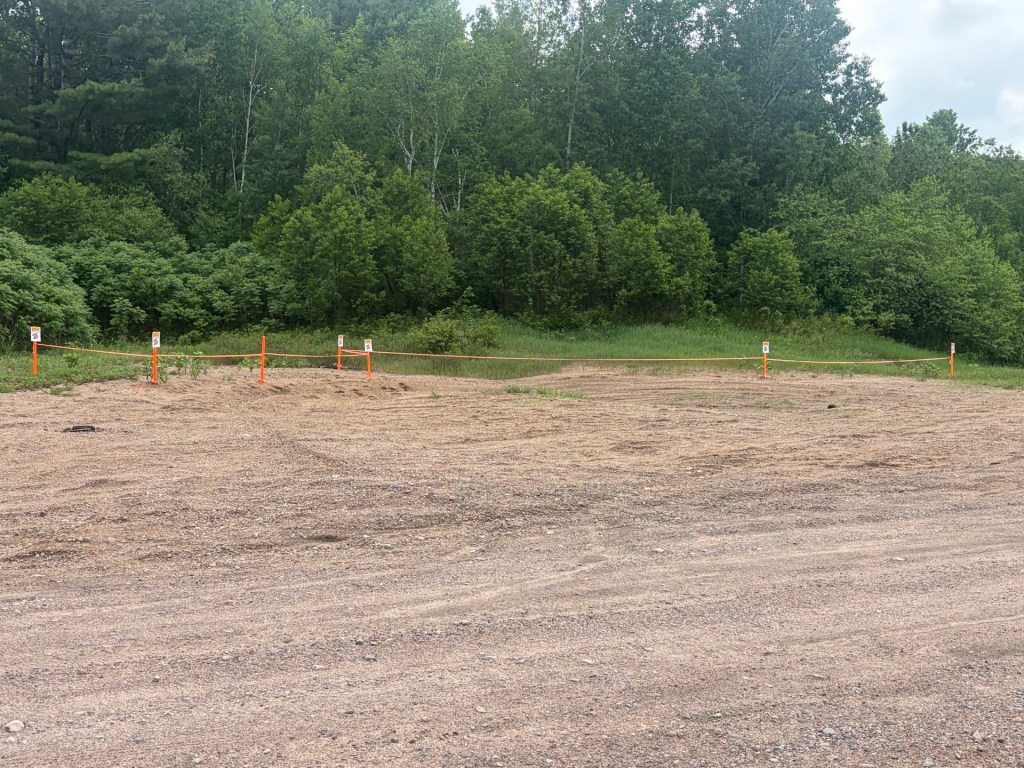
Photo above from left to right is a Large Patch of Milkweed Plants
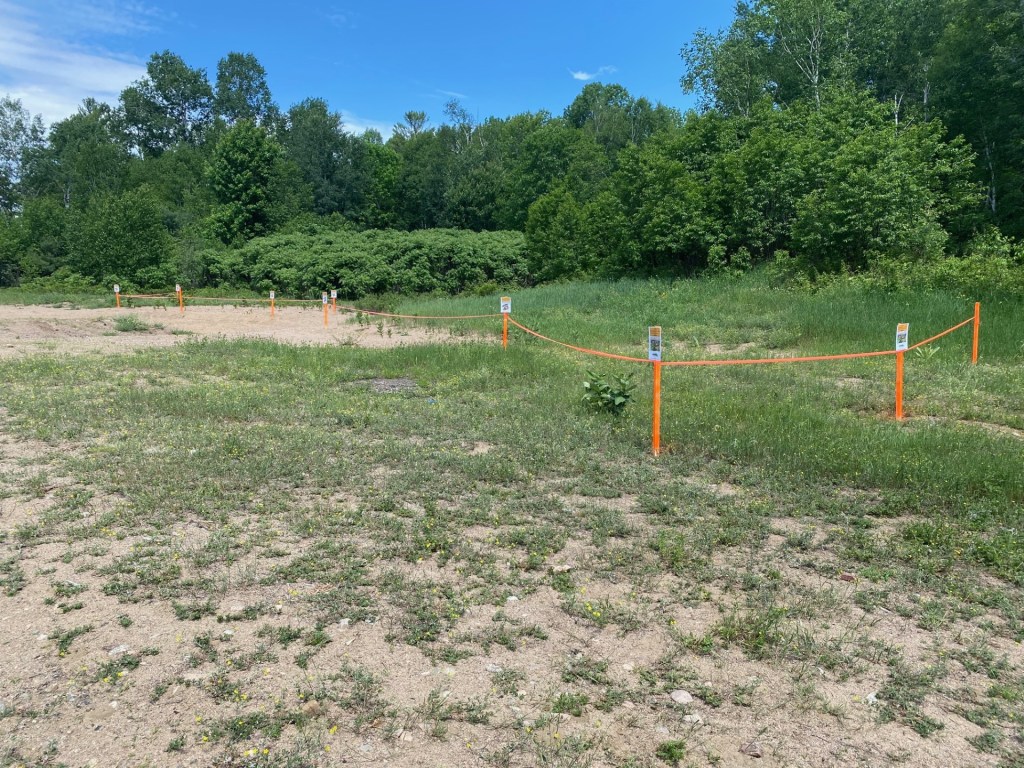
Photo above from right to left is the same Large Patch of Milkweed Plants
Seeing as milkweed is extremely important to monarch butterflies, we ask you to please be extra careful when visiting this site. Avoid driving over, trampling, or otherwise damaging any milkweed plants so they can continue to provide essential habitat and food for monarchs.
During this solo field trip on June 16, 2026, Denise Chaput observed that turtles had already begun nesting. While installing 4-foot pickets with signs and orange flagging tape, she discovered three turtle nesting sites. As protective cages were not available at the time, we will need to return to install cages over the nests to help protect them from predators and other disturbances.
Field Trip – June 23, 2026
On June 23, 2026, Larry Henry and Denise Chaput conducted a field trip to monitor turtle nesting activity. With the assistance of a permanent camper Mr. Ken Reid, we were able to easily locate the turtle nests, as he had previously marked them using stakes and orange flagging tape.
Unfortunately, we were too late to protect one of the nests. When we located it, a predator had already dug it up, highlighting the challenges turtles face during nesting season.
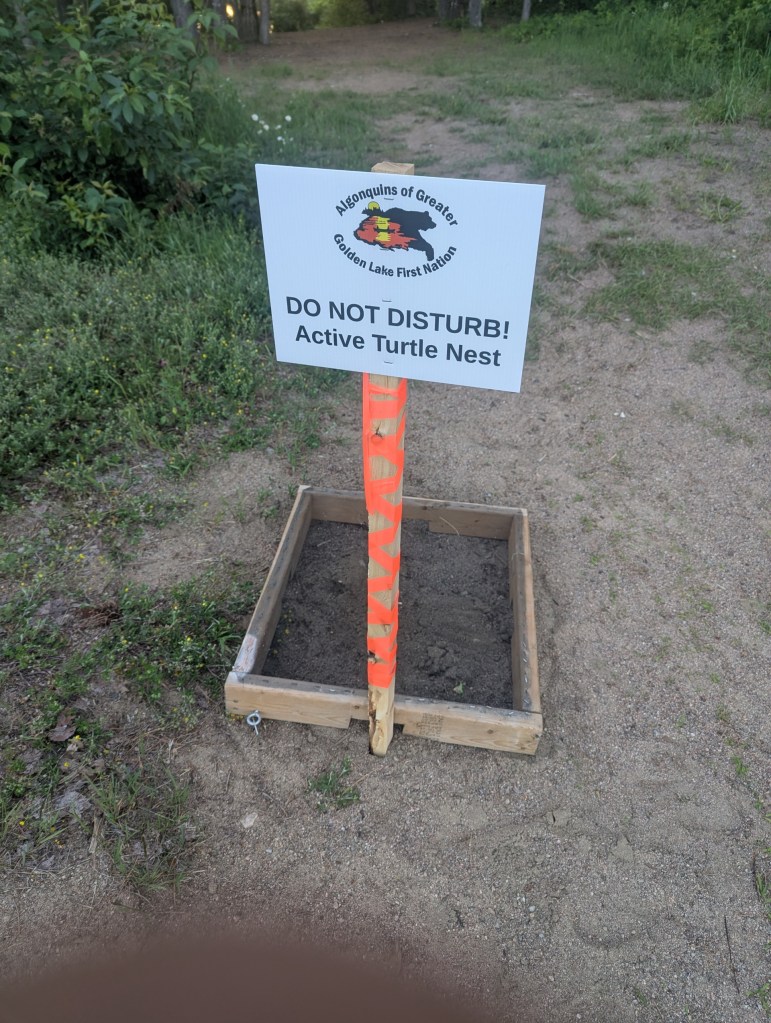
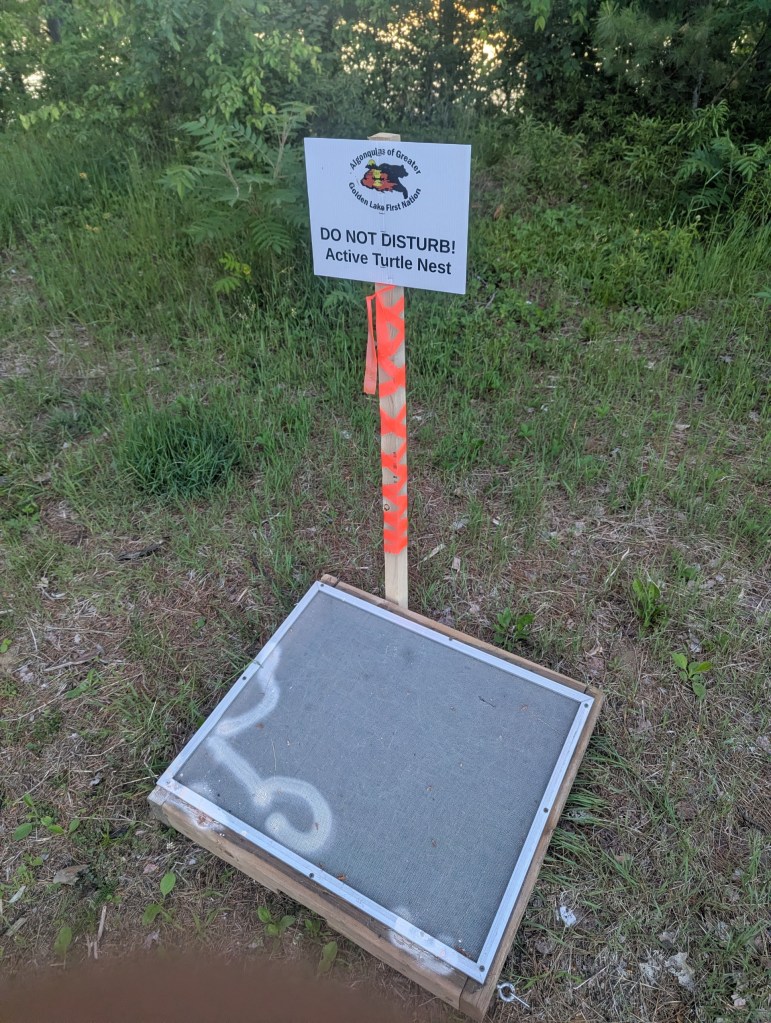
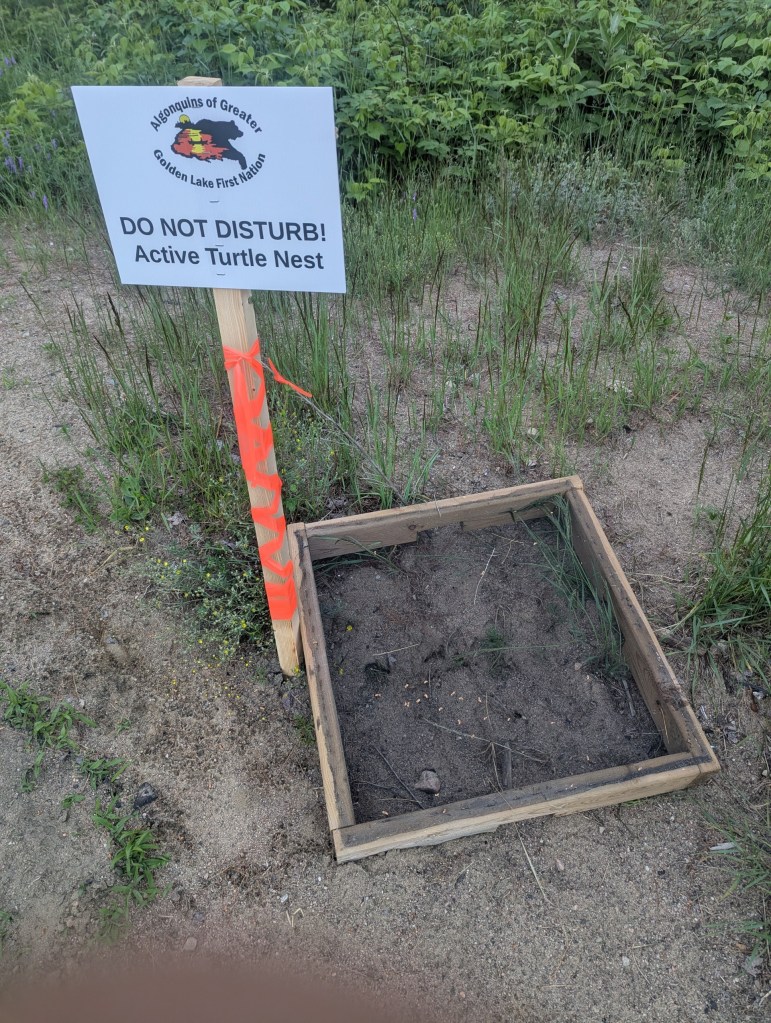
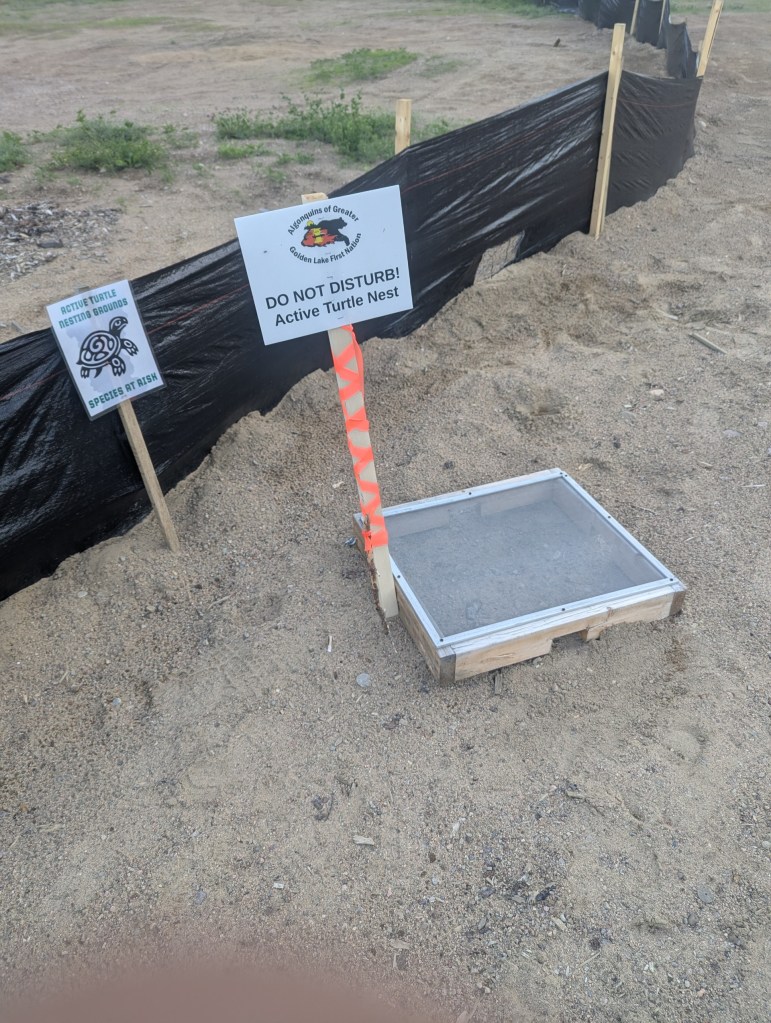
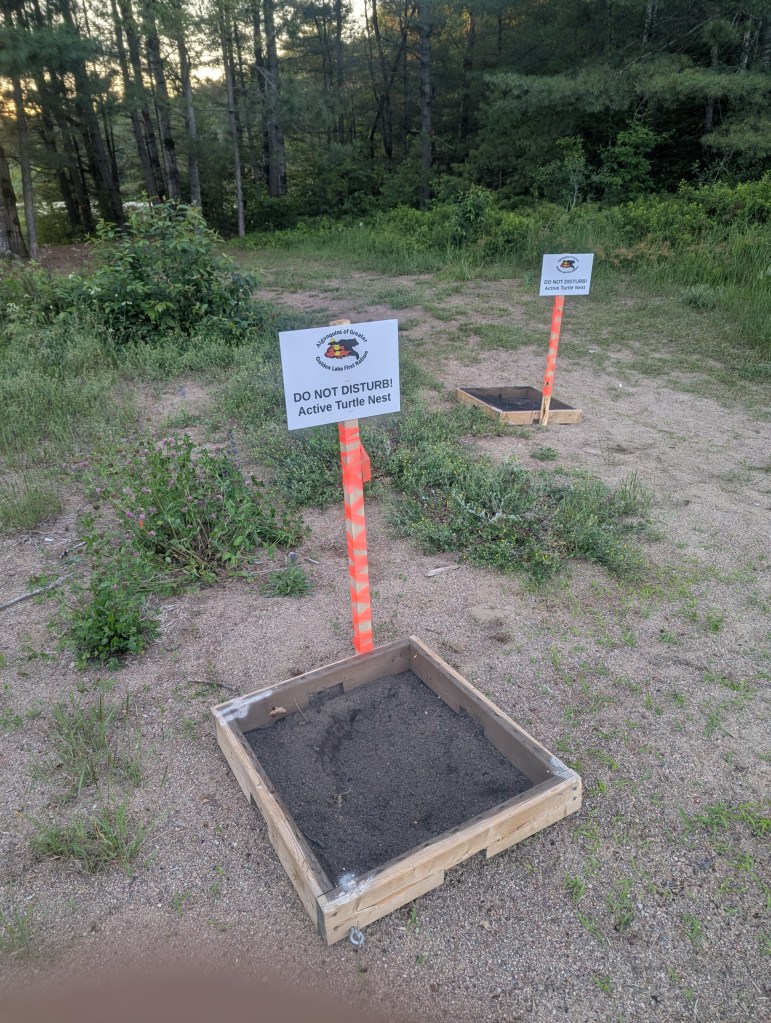
During this visit, we installed six protective turtle nesting cages, each equipped with appropriate signage to help protect the nests from disturbance and predation. {See photos below}
We had two additional protective cages available. These were left with Mr. Reid so that he can install them if he observes any additional turtle nesting activity before our next visit to the site with more cages.
We appreciate Mr. Reid’s ongoing assistance and vigilance in helping to identify and protect turtle nesting sites.
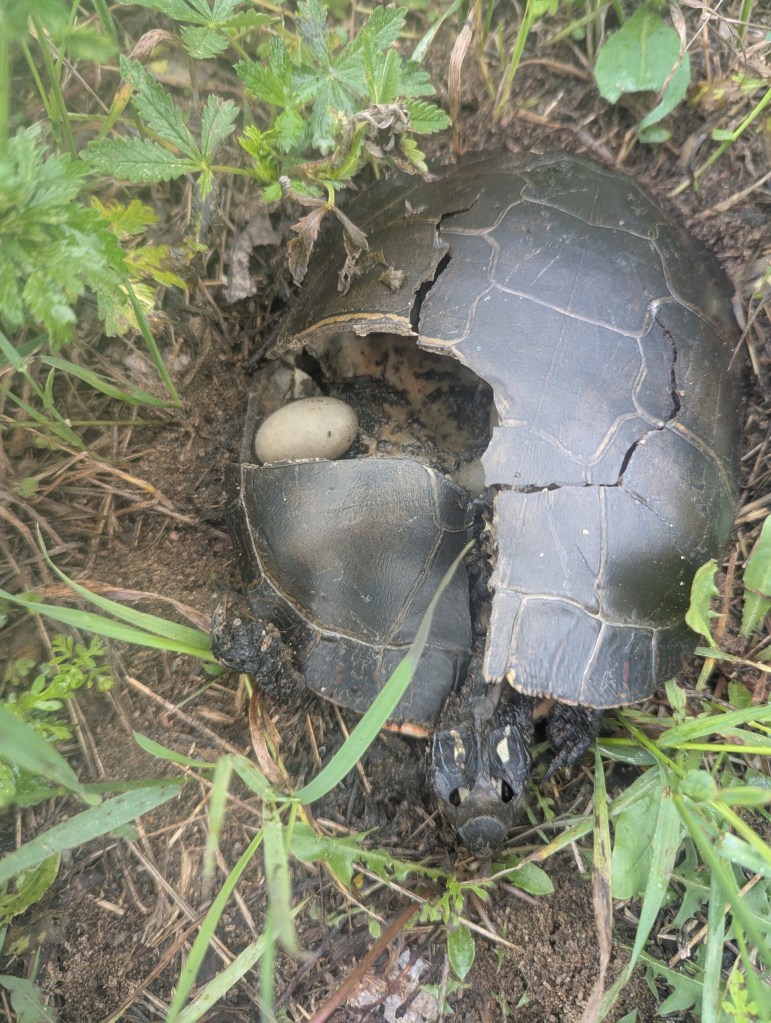
Please see the photos below, which were sent to Denise Chaput, documenting the turtles nesting and tragically, one turtle was found dead while attempting to reach a suitable nesting location.
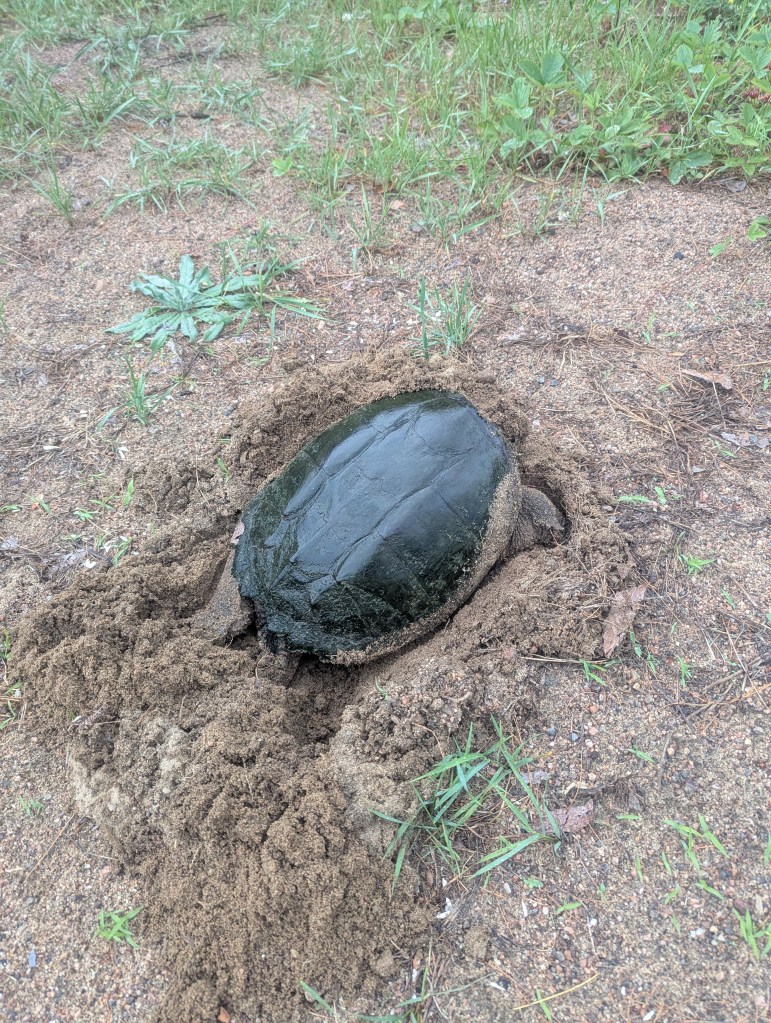
This female turtle is fresh out of the lake and quickly on route to find the perfect nesting location.
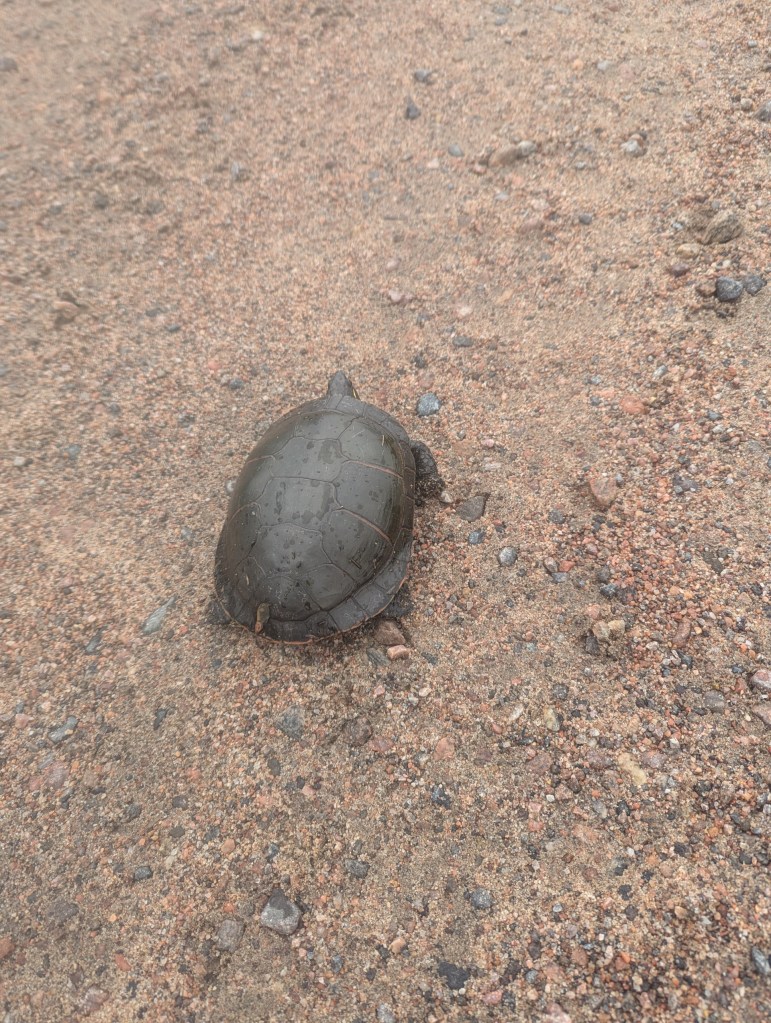
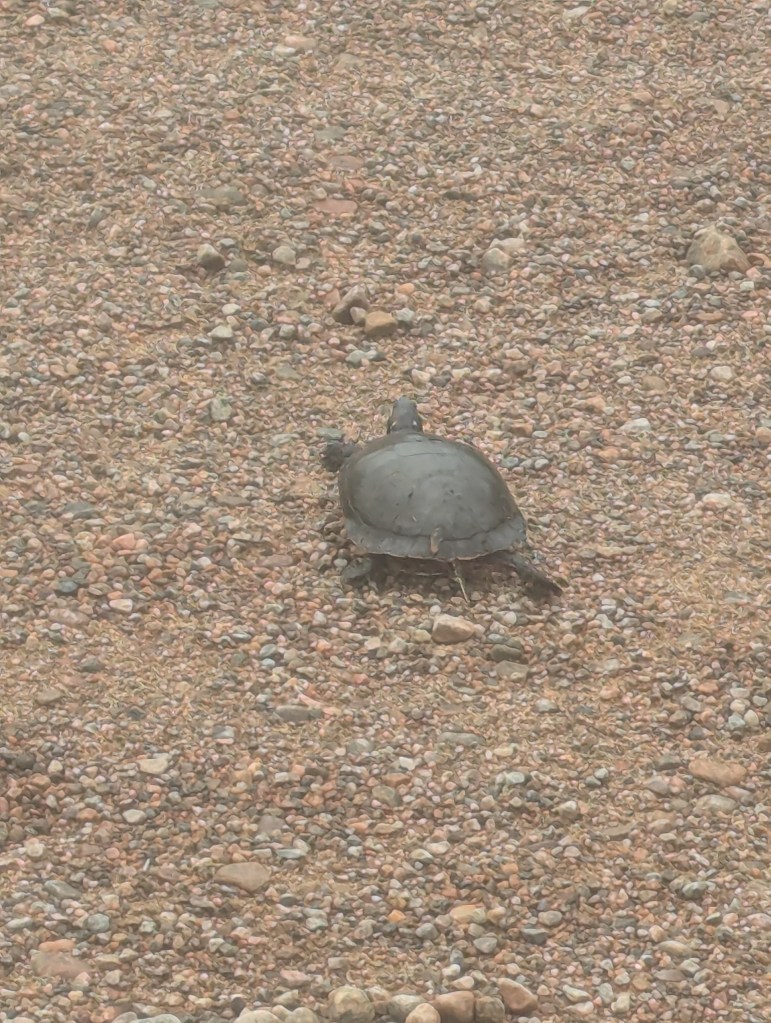
These two female turtles appeared to favor these spots for laying their eggs.
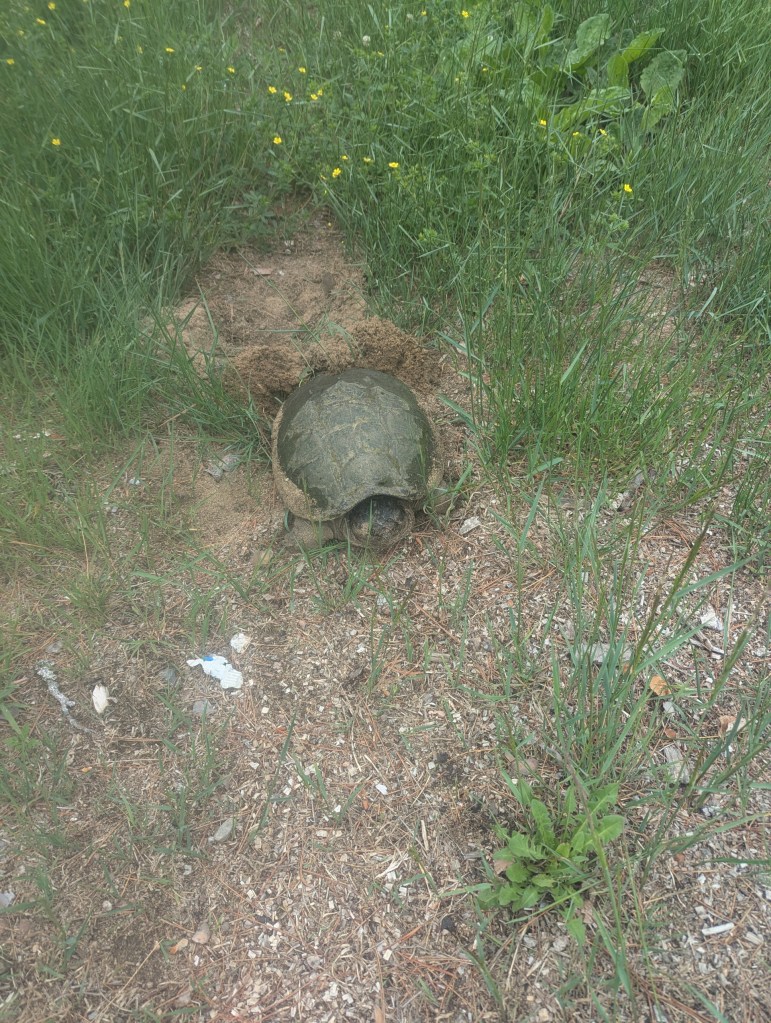
This is a difficult photo to share, but we wanted to show the tragedy that can occur at Sand Lake when people are not attentive. This female turtle was killed while traveling to a nesting site to lay her eggs. Please help protect our local wildlife by remaining vigilant and driving carefully.
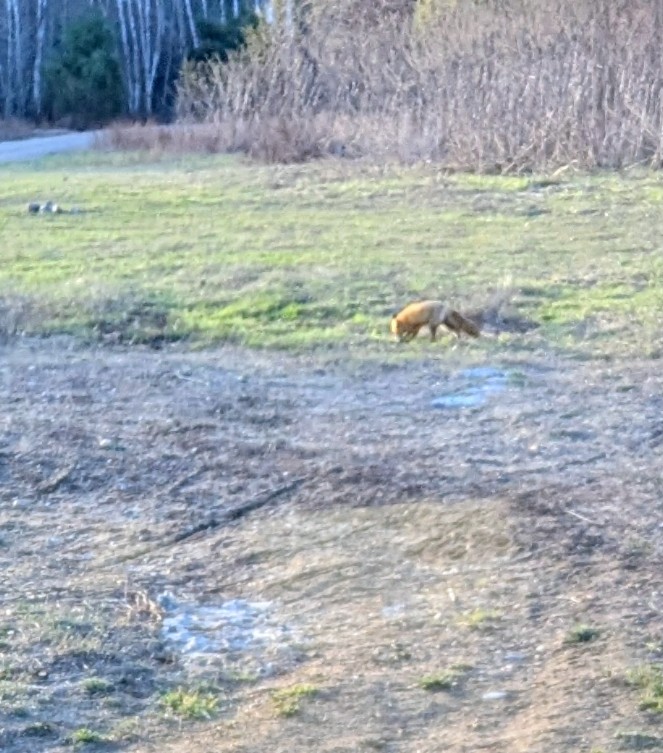
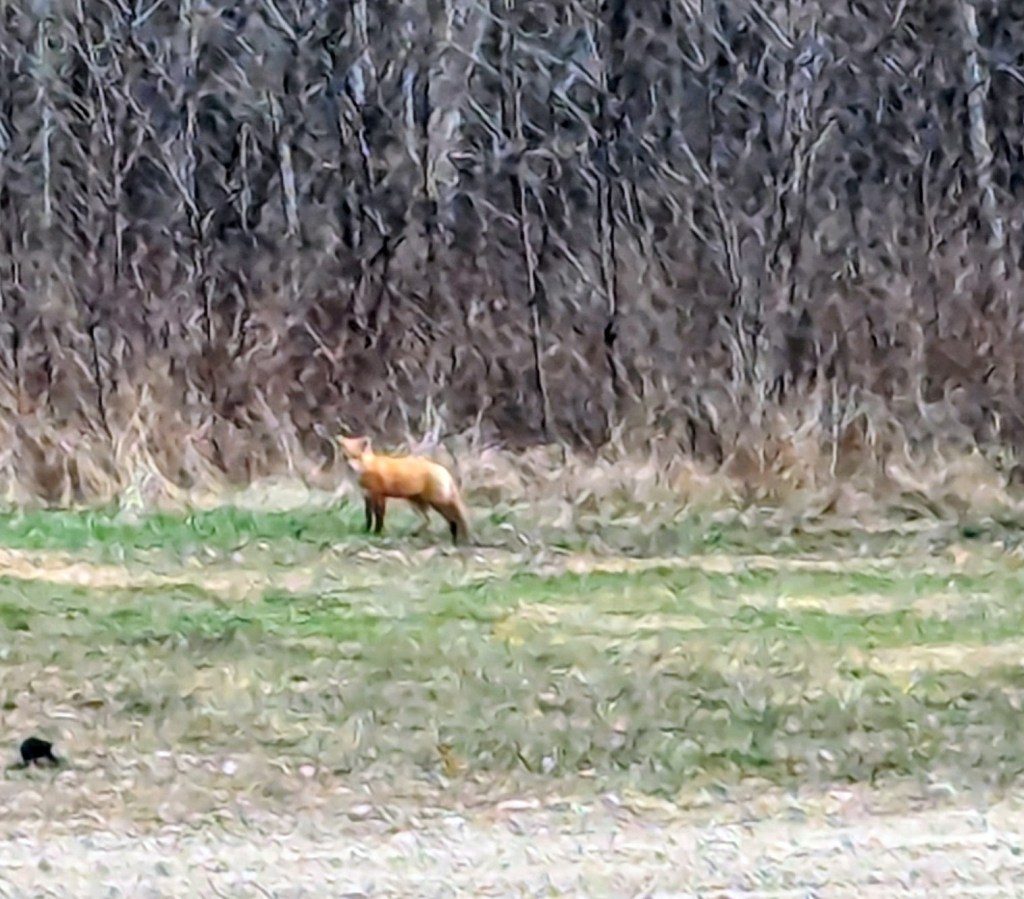
This fox is one of the predators we try to keep away from turtle nests, but she’s also a devoted mother raising a family of five. Nature is rarely simple—while we’re working to protect vulnerable turtle eggs, she’s simply doing what she needs to do to feed her young.
We are aware that predation is a natural part of the ecosystem and the cycle of life. However, turtles are the ones at risk, with many species facing population declines, which is why we are working so diligently to protect them.
6 Protective Turtle Nesting Cages Installed on June 23, 2026 Field Trip
Field Trip – June 29, 2026
A solo field visit was conducted by Denise Chaput to assess the site for any damage to the recovery strategies currently in place. During the visit, Denise spoke with the permanent camper, Ken Reid, regarding site conditions and turtle nesting activity. Ken reported that he had installed one additional turtle nest protective cage during the previous week over a newly identified nesting site. This brings the total number of protected turtle nesting sites at Sand Lake to seven.
Ken shared with Denise that there have been a couple of sightings of Monarch butterflies in the area between June 24-June 28, 2026. These observations are encouraging and have been noted as an indication that the habitat continues to support important pollinator species.
Before departing, Denise prepared four 4-foot pickets with orange flagging tape and attached signs for use at the site. She also delivered four additional protective turtle nesting cages for Ken to install over any new turtle nesting sites he identifies.
The four additional turtle nest protective cages were constructed over the previous weekend by Vance Mathieu and Denise Chaput and donated in support of the ongoing turtle conservation and recovery efforts at Sand Lake.
Vance Mathieu also purchased and donated the orange flagging tape and two packages of 25 four-foot wooden pickets for use in marking and protecting turtle nesting sites. These donated materials will support the continuation of the project’s monitoring and conservation efforts throughout the nesting season.
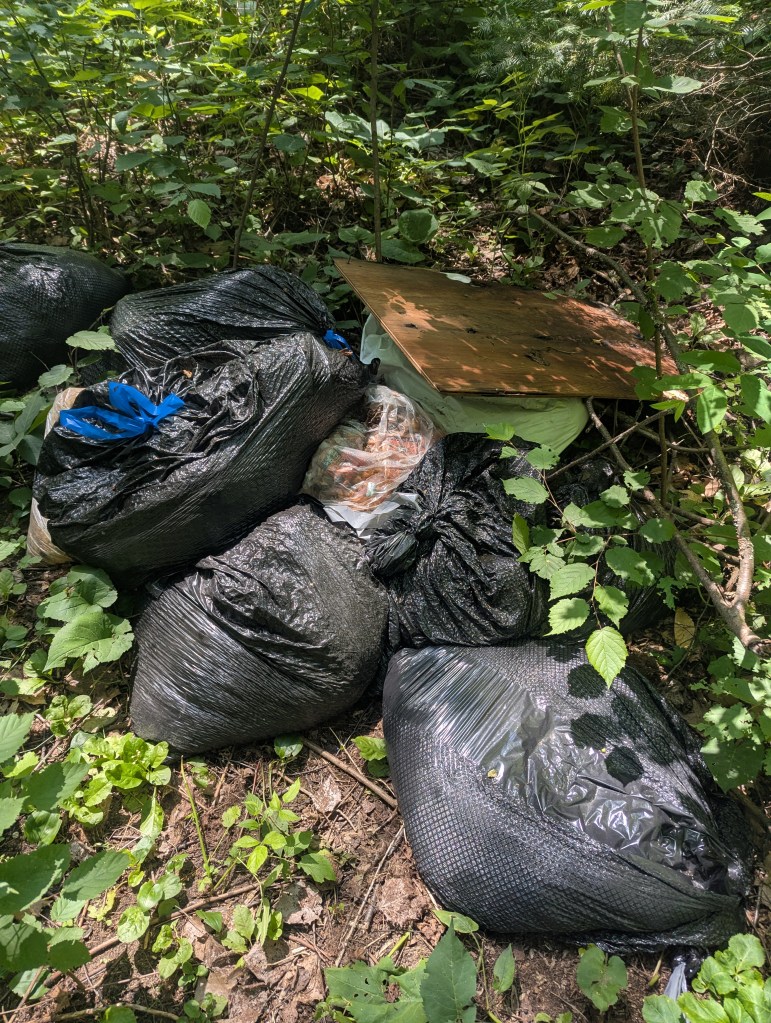
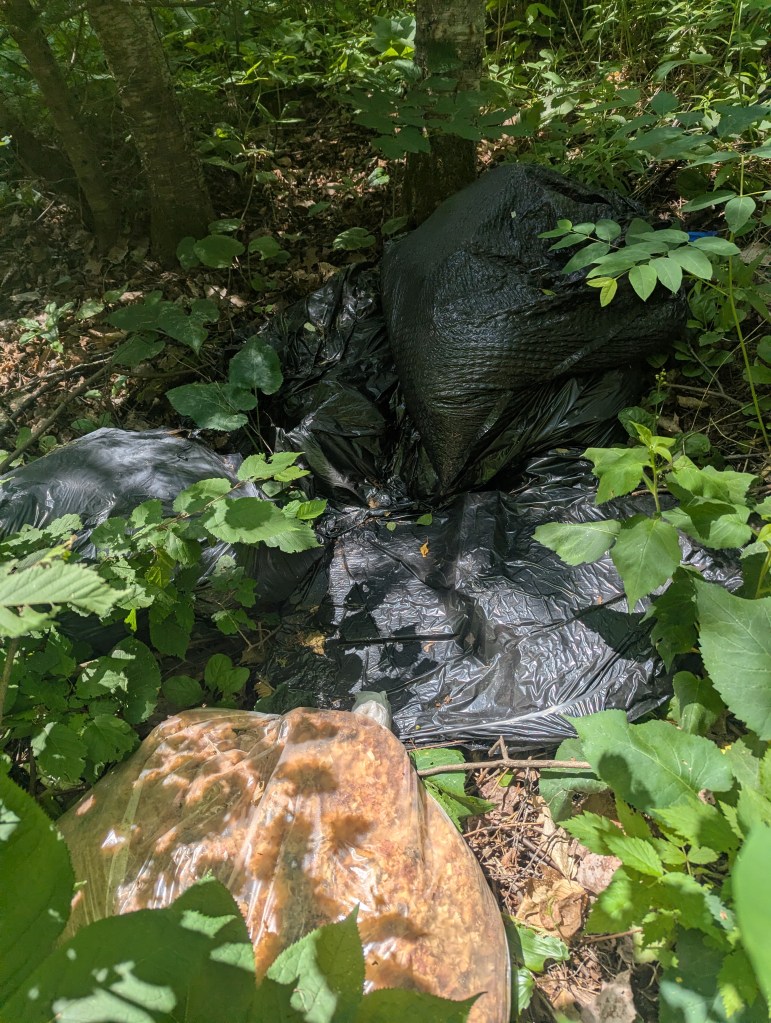
During this site visit, Denise was also informed of an environmental concern involving another camper who was reportedly disposing of bags of used kitty litter in the bush behind their trailer. This type of waste disposal is not acceptable due to the potential environmental impacts and risks to wildlife.
Photo Caption:
The same day this incident was reported to the Ministry of Natural Resources (MNR), and a request was made for a follow-up visit to Sand Lake to investigate the matter and, if appropriate, speak with the camper regarding proper waste disposal practices.
Solo Field Trip – July 6, 2026
Denise Chaput visited the Sand Lake Project this morning before heading to the office. Overall, the site was in good condition, and there was no damage to any of our recovery strategies.
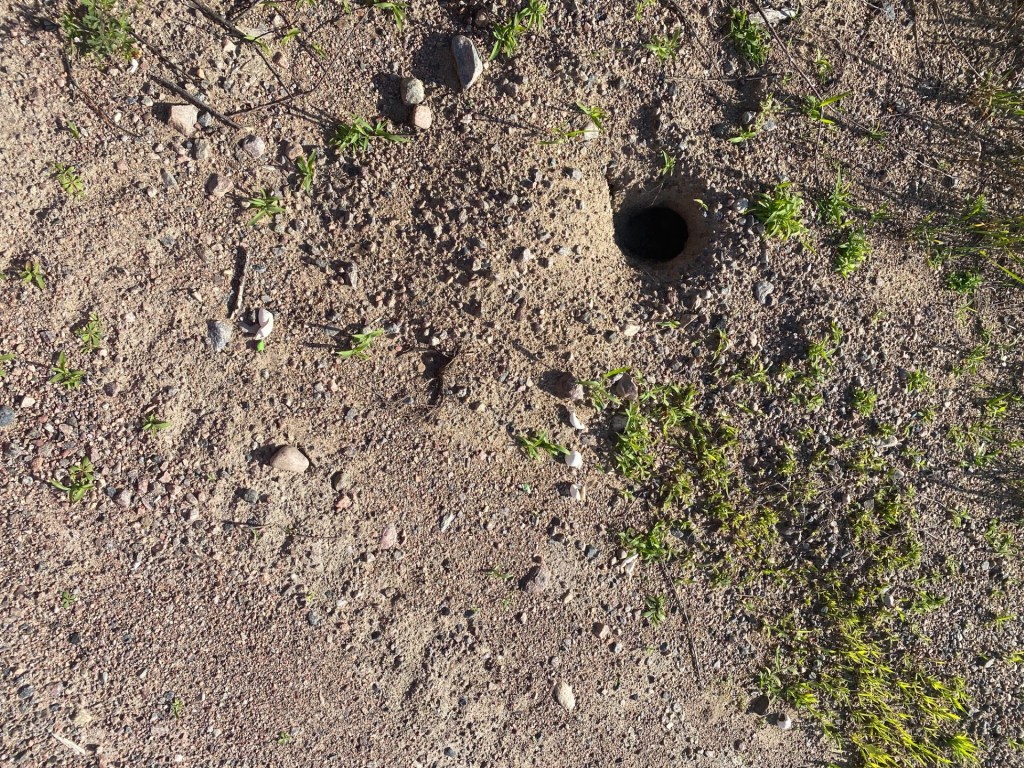
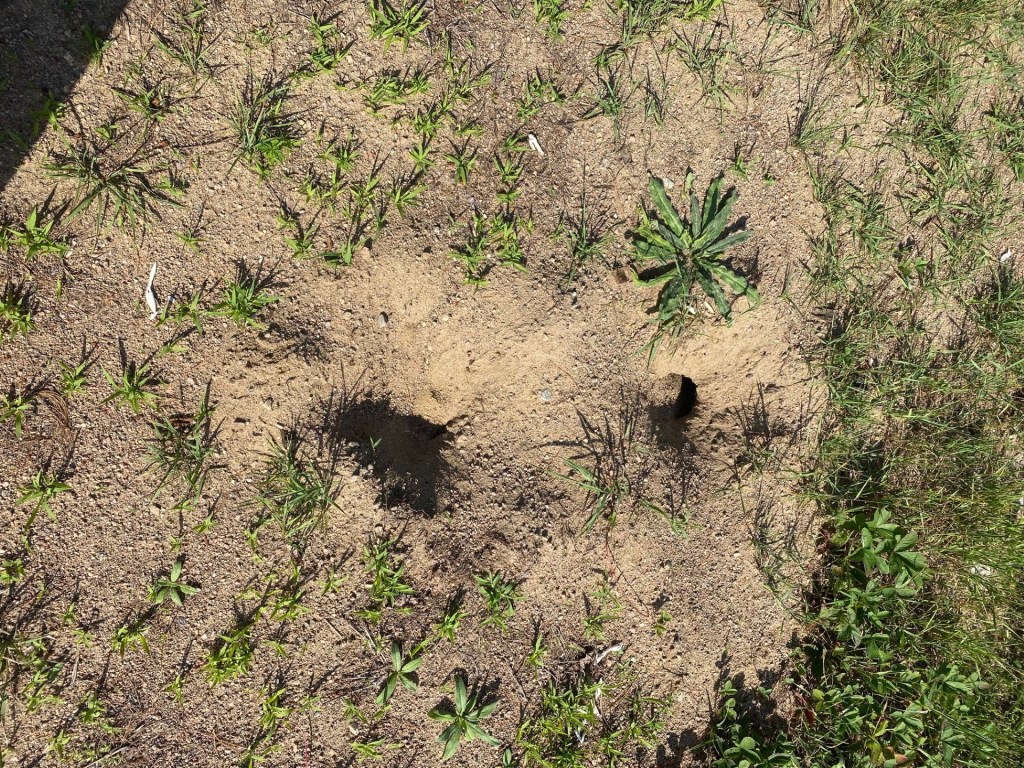
We currently have seven protective turtle nesting cages in place. However, Denise discovered that two turtle nests had been dug up by the resident fox, a female that is raising five kits in the area.
Denise also took a close look at the milkweed plants and was pleased to find two monarch caterpillars, each on a different milkweed plant. While this was encouraging, it is significantly fewer than the number of monarch caterpillars we found at this site at the same time last year.
Photo Caption:
The two photos below show one of the monarch caterpillars that Denise discovered on a milkweed plant. Because it was tucked among the leaves, she was unable to get a clear photograph. Even so, the images document this encouraging observation at the Sand Lake Project.
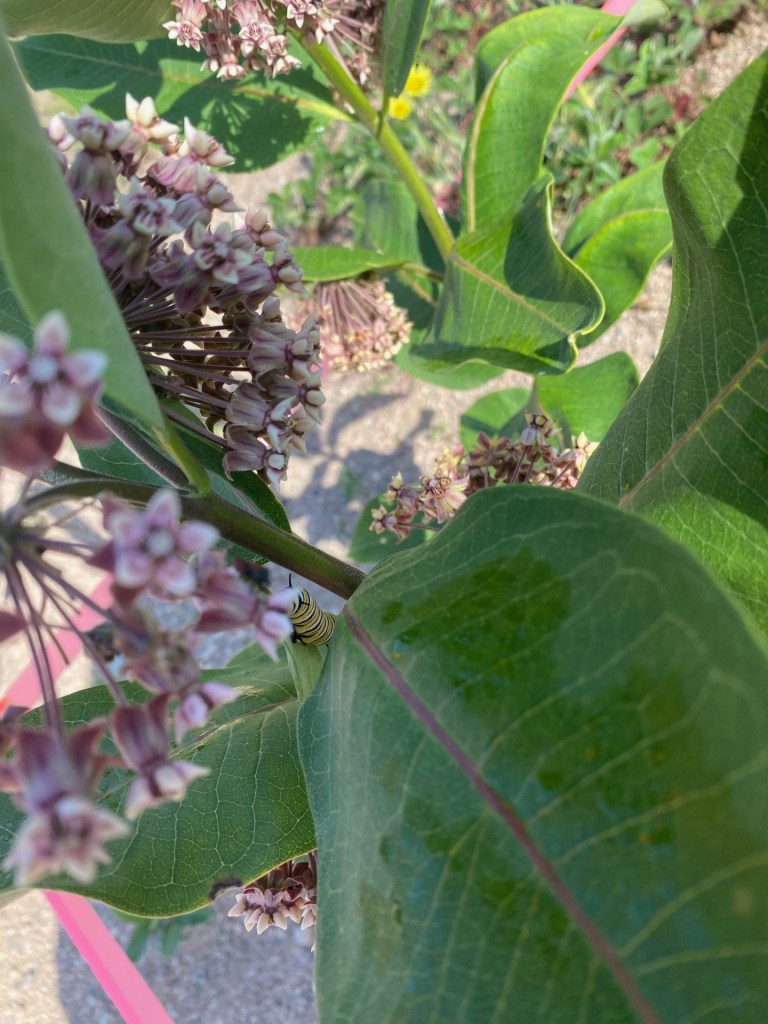
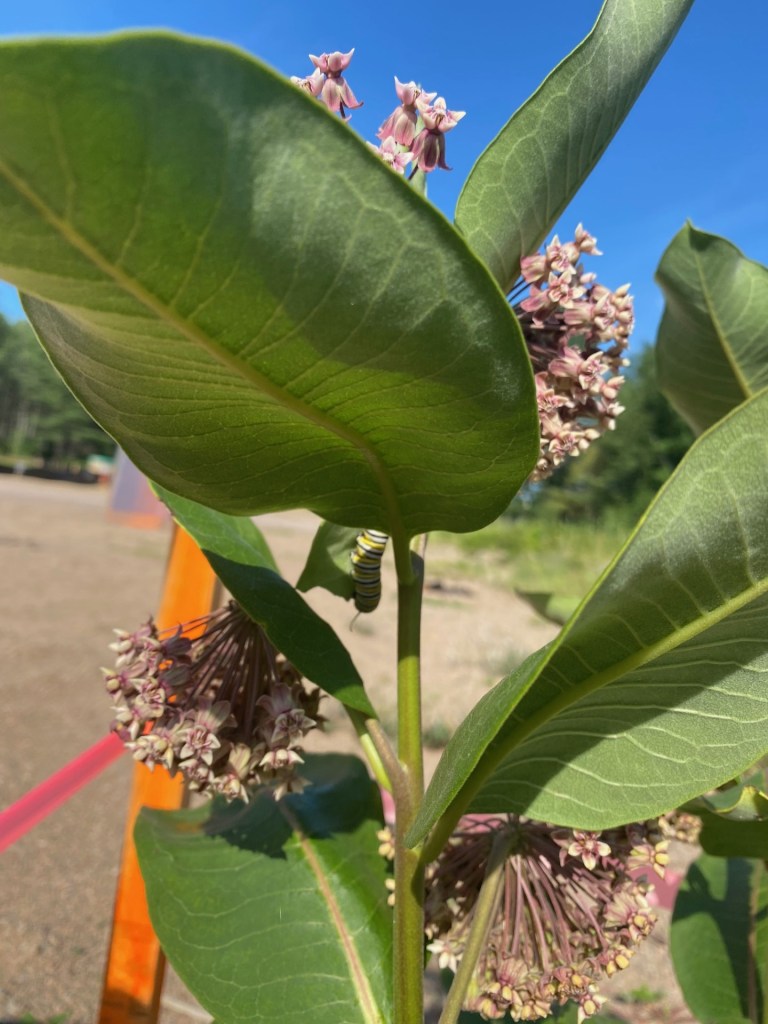
Photo Caption:
Below is a clear photograph of the second monarch caterpillar that Denise found on a different milkweed plant. This individual was much easier to photograph, providing a good view of its distinctive markings.
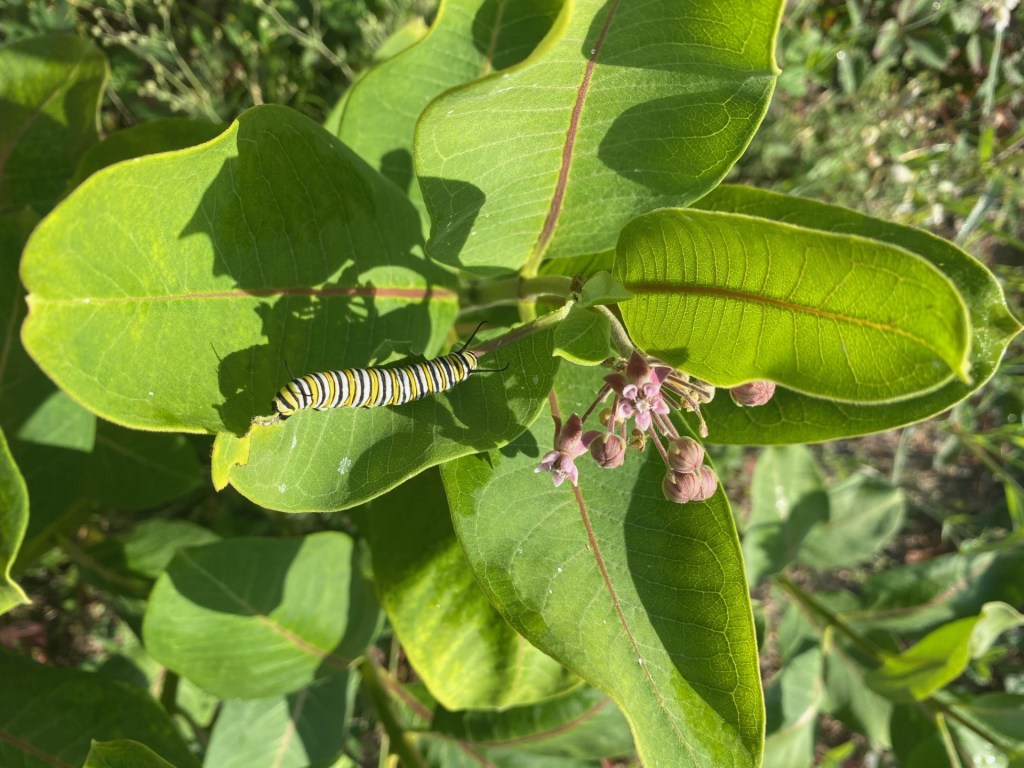
Photo Caption:
The photo below shows the fenced milkweed patch and tons of native wildflowers where the two monarch caterpillars were discovered. This protected area continues to provide important habitat for monarch butterflies and other pollinators at the Sand Lake Project.
So far this season, the permanent camper Ken Reid, has observed only a single monarch butterfly, which was seen about a week ago. He has, however, reported seeing several other butterfly species, including the Eastern Tiger Swallowtail and the White Admiral.
Photo Caption:
The photo below shows the same area that was photographed during my Solo Field Trip on June 29, 2026, where bags of used kitty litter had been illegally dumped in the bush.
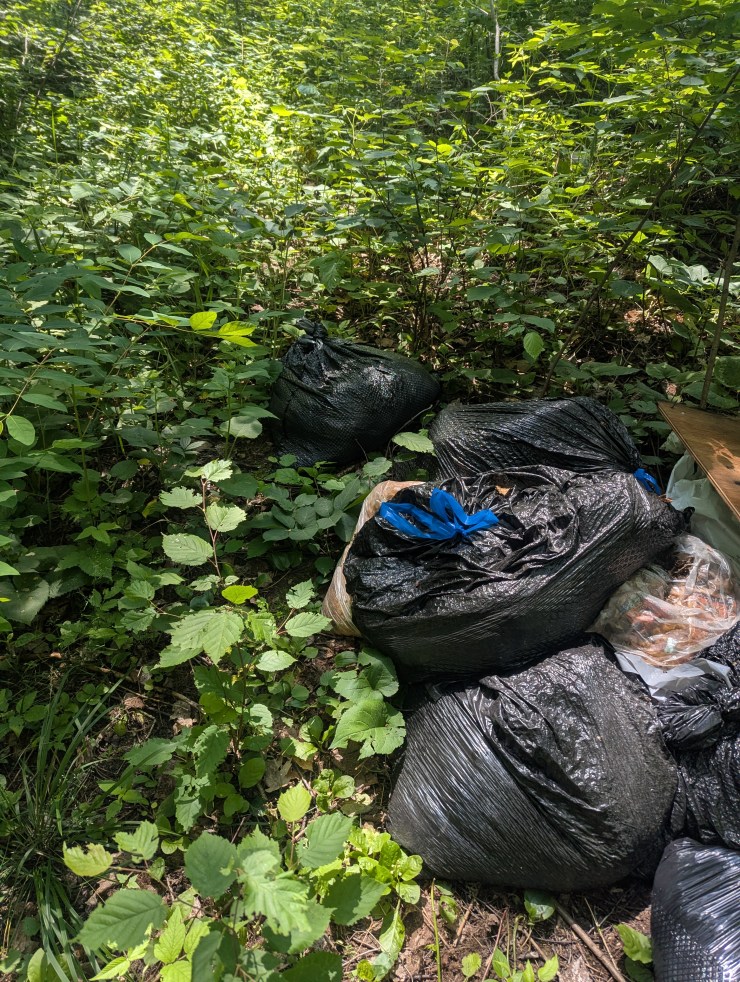
Today, Denise can confirm that a staff member from the Ministry of Natural Resources (MNR) visited the site on July 3, 2026, to speak with the individual who had illegally dumped bags of used kitty litter in the bush. The individual was instructed to remove the waste and dispose of it properly by today, July 6, 2026. Just before my arrival this morning, the bags had been removed, and the area had been cleaned up.
We are very pleased to see that the site has been restored and appreciate that the MNR followed up so promptly after we reported the illegal dumping last week. Their response helped ensure the issue was resolved quickly and that the natural habitat remains protected.
Photo Caption:
The photos below show the large area that we completely enclosed with snow fencing (safety fencing) to protect an extensive patch of milkweed and native wildflowers. This protected habitat provides an important refuge for monarch butterflies and their caterpillars, as well as many other native pollinators and wildlife species. By limiting human disturbance, we are helping these plants thrive and supporting the recovery of this valuable natural habitat.
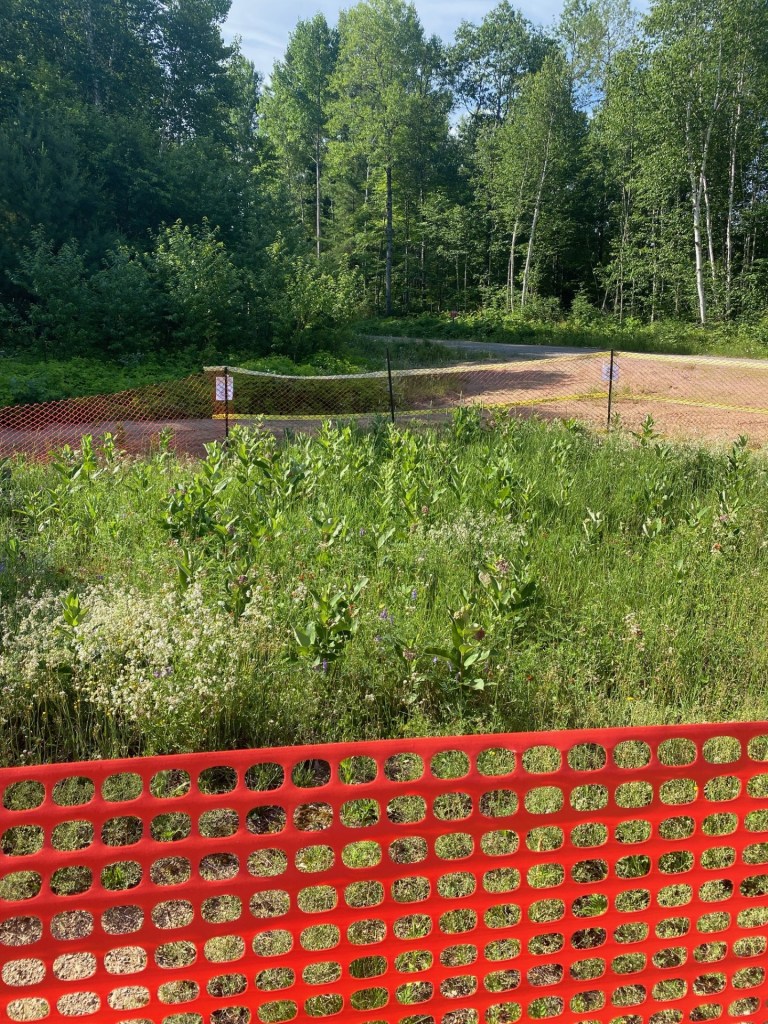
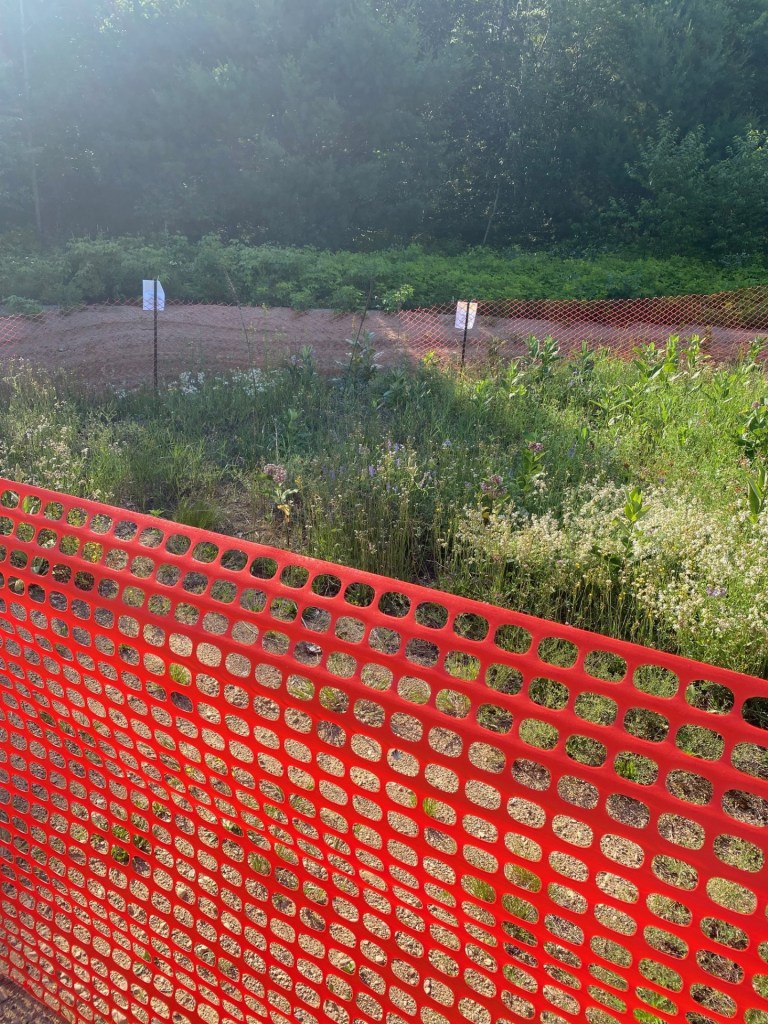
It was encouraging to see that the milkweed plants and native wildflowers continue to thrive despite the prolonged heat wave we have experienced over the past several weeks. Their healthy growth is providing valuable habitat and food sources for monarch butterflies, other pollinators, and a variety of native wildlife.
Species At Risk 2026 Project # 2 Update
Last year, we observed six Blanding’s turtles at Sand Lake, including one female nesting along the side of Baron Canyon Road, just a few kilometers before the entrance to Sand Lake. This year, however, we are saddened to report that we have not sighted any Blanding’s turtles at Sand Lake so far.
We also observed many more Monarch butterflies and countless Monarch caterpillars during the 2025 field season. This year, I have received only one report of a single Monarch butterfly, and I have personally found just two Monarch caterpillars.
Although the turtles nesting at Sand Lake are not all Blanding’s turtles, we are committed to protecting every turtle species we find. All turtles play an important role in the ecosystem, and many face significant threats at Sand Lake due to heavy human activity, including increased vehicle and foot traffic.
By protecting nesting sites and raising awareness, we hope to give as many turtles as possible a better chance of surviving and contributing to healthy populations for future generations.
Although the number of sightings has been much lower this season, we remain hopeful that more of these species at risk will be found at Sand Lake as the season continues. We will keep monitoring the area and appreciate everyone who helps by reporting their sightings. Every observation contributes to our understanding and conservation of these important species.
We would also like to extend our sincere appreciation to the permanent campers—especially Ken Reid—as well as the day users of Sand Lake for their cooperation, assistance, and respect for the recovery measures we have put in place. Your support and understanding play an important role in helping us protect species at risk and their habitats, and we are truly grateful for your continued commitment to these conservation efforts.

